State Details
Massachusetts

Overview | |
|---|---|
State | Massachusetts (MA) |
Capital | Boston |
Statehood | 1788 |
Population | 7,001,399 |
Gun Ownership | 22.6% |
Active FFLs | 340 |
Carry Laws | |
Constitutional Carry | No |
Open Carry | Licensed |
CCW Permit Available | Yes |
Permit Reciprocity | none |
Self-Defense | |
Castle Doctrine | Yes |
Stand Your Ground | No |
Duty to Retreat | Yes |
Regulations | |
State Preemption | No |
Red Flag / ERPO | Yes |
Waiting Period | None |
Universal BGC | Yes |
NFA Items | No |
Assault Weapons Ban | Yes |
Magazine Limit | 10 rounds |
Key Legislation | |
| |
Notable Manufacturers | |
| |
Massachusetts Firearms History
Reference article
From The Boise Gun Club Handbook
Overviewedit
Massachusetts sits at the intersection of American firearms history more than almost any other state. The first shots of the Revolutionary War were fired here. The federal government's most important armory operated here for nearly two centuries. Smith & Wesson still manufactures here. And the state legislature has spent three centuries layering firearms regulations that today rank among the most restrictive in the country.
That combination — birthplace of the armed citizen's rebellion against tyranny, and home to some of the most aggressive gun control legislation in the nation — defines Massachusetts gun culture and the tensions that still run through it.
Understanding how you got here requires going all the way back to a powder house in Somerville and a green in Lexington.
Colonial & Revolutionary Eraedit
Massachusetts colonists had a complicated relationship with firearms from the start. On one hand, survival required them. The colony sat on a contested frontier, and every household depended on muskets for food and defense. On the other hand, the colonial government moved quickly to regulate who could have them.
Early Colonial Regulations
In 1633, the Massachusetts Bay Colony enacted one of the earliest firearms laws in what would become the United States — a prohibition on transferring firearms, gunpowder, or ammunition to Native Americans. The law reflected both genuine fear of armed conflict and the colony's desire to maintain a military advantage over indigenous populations. It was a template other colonies would copy.
| Year | Event | Significance |
|---|---|---|
| 1633 | Firearms transfer ban | First firearms law in future United States |
| 1774 | Powder Alarm (Sept 1) | British seize colonial powder stores, mobilizes thousands |
| 1775 | Lexington & Concord (April 19) | "Shot heard 'round the world" begins Revolutionary War |
| 1777 | Springfield Armory established | Washington orders creation of military arms facility |
| 1783 | Boston loaded firearms ban | Early peacetime restriction on home storage |
By the mid-18th century, the powder supply had become as politically charged as the firearms themselves.
The Powder Alarm
September 1, 1774, General Thomas Gage ordered British troops to seize the colonial powder stores at the Quarry Hill Powder House in what is now Somerville — the largest powder magazine in New England. Gage's men removed 250 half-barrels of powder before colonial militiamen could respond. The Powder Alarm, as it came to be called, electrified the colonies. Thousands of armed men mobilized within hours, and though no shots were fired that day, the episode accelerated militia organizing throughout Massachusetts and pushed the colonies toward open conflict.
Lexington, Concord, and the Birth of Armed Resistance
The shots came seven months later. On April 19, 1775, colonial militiamen at Lexington faced a British column under Lieutenant Colonel Francis Smith marching to seize weapons and ammunition stockpiled at Concord. The militiamen at Lexington were armed with a mix of privately owned muskets — Brown Bess patterns, fowling pieces, some French arms — none of it standardized. At the North Bridge in Concord, the militiamen fired the famous volley that began the war in earnest. The British column's return to Boston turned into a running ambush along the Battle Road, with colonial shooters using terrain, stone walls, and their familiarity with the ground to devastating effect.
What happened next set Massachusetts apart permanently in American firearms history. General George Washington, appointed commander of the Continental Army in June 1775, recognized immediately that the colonies had no reliable means to manufacture or store military arms at scale. In 1777, he ordered the establishment of a magazine and storage facility on a commanding hill above Springfield, Massachusetts — chosen for its defensible position, its distance from the coast, and its access to the Connecticut River for transport. That order created what would become the Springfield Armory, the institution that shaped American manufacturing for the next century and a half.
Key events establishing Massachusetts as the center of Revolutionary-era firearms history
Massachusetts also enacted, in 1783 — while the ink on the peace treaty was barely dry — a law prohibiting the storage of loaded firearms in homes within the town of Boston. The stated rationale was fire prevention; the practical effect was one of the earliest peacetime restrictions on how Americans could keep their own guns. It was a preview of the regulatory instinct that would define Massachusetts policy for generations.
19th Century: The Armory, the Valley, and Early Regulationedit
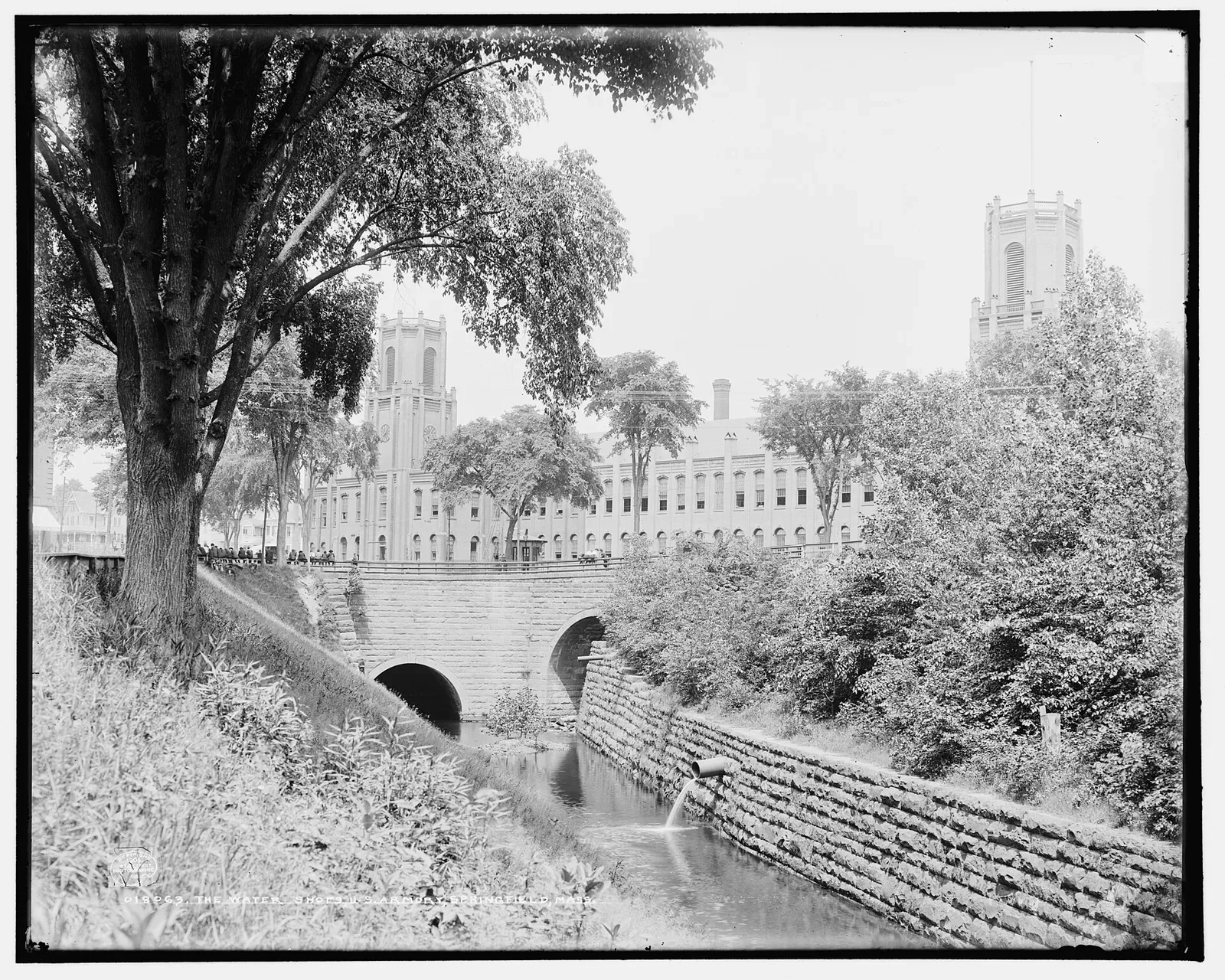
The Springfield Armory began manufacturing muskets in the 1790s, producing its first standardized flintlock — the Model 1795 Musket — based on the French Charleville pattern. What Springfield did next mattered more than any single weapon it produced: it became the laboratory for interchangeable parts manufacturing.
The American System of Manufacturing
The Armory's superintendent Roswell Lee, who ran the facility from 1815 to 1833, pushed relentlessly for precision and standardization. Under his direction, the Armory's workforce expanded and its occupational specialties multiplied — from 36 distinct trades in 1815 to 86 by 1820 and 100 by 1825. Machine tools replaced hand fitting. Parts gauged to precise tolerances replaced parts fitted individually by skilled craftsmen. What emerged from this process became known as the American System of Manufacturing — a method of production that would eventually transform not just firearms but American industry broadly.
Evolution of the American System of Manufacturing at Springfield Armory
Springfield's influence radiated outward through the Connecticut River Valley, creating a concentration of precision metalworking shops, tool manufacturers, and machinist talent stretching from Springfield south into Connecticut. This valley became the center of American firearms manufacturing in the 19th century, and Massachusetts firms were at its heart.
Private Manufacturers in the Valley
Ethan Allen established his percussion arms business in Grafton in the 1830s, eventually partnering with his brother-in-law Charles Thurber and later Thomas Wheelock. Allen's pepperbox revolvers — multi-barreled rotating pistols — were among the most widely sold handguns in America before Colt's single-cylinder revolvers took over the market. Allen & Wheelock later produced solid revolvers that competed directly with Colt and Remington.
In 1852, Horace Smith and Daniel Wesson formed their first partnership in Norwich, Connecticut, but the venture that established them came when they reorganized as Smith & Wesson in Springfield, Massachusetts, in 1856. They had acquired the rights to Rollin White's patent for a bored-through cylinder — the key to loading metallic rim-fire cartridges from the rear. The Smith & Wesson Model 1, chambered in .22 Short, was the first commercially successful American revolver to use self-contained metallic cartridges. White's patent, which S&W enforced aggressively until its expiration in 1869, kept every competitor — including Colt — out of the metallic cartridge revolver business for over a decade.
| Company | Founded | Location | Notable Products |
|---|---|---|---|
| Ethan Allen | 1830s | Grafton | Pepperbox revolvers |
| Smith & Wesson | 1856 | Springfield | Model 1 (.22 Short), first metallic cartridge revolver |
| Iver Johnson | 1871 | Fitchburg/Worcester | Affordable revolvers, mail-order sales |
| Harrington & Richardson | 1871 | Worcester | Single-shot revolvers, shotguns |
Civil War Production Surge
The Civil War accelerated everything. Springfield Armory went to full wartime production, turning out Model 1861 and 1863 rifle-muskets at a pace that dwarfed any previous American manufacturing effort. By 1864, the Armory was producing nearly 300,000 rifle-muskets per year — a number that required the parallel development of machine tools, workforce systems, and quality control processes that had no precedent. Private contractors throughout Massachusetts and the Connecticut Valley supplemented Armory production, and the metalworking infrastructure built during the war years provided the foundation for the state's industrial dominance in the decades that followed.
Smith & Wesson supplied the Model 2 Army revolver in .32 rim-fire to Union officers — a commercially sold weapon that soldiers purchased privately, since the Army had not yet adopted a S&W revolver for issue. Officers and enlisted men bought them by the thousands. The company's Springfield factory ran continuously through the war.
Early Carry Restrictions
Massachusetts also moved on regulation during this period. The state restricted public carry of firearms in the 1830s, establishing an early requirement that persons carrying concealed weapons demonstrate reasonable cause to fear attack — one of the earliest such statutes in the country. It was a meaningful departure from the open-carry norms of the frontier states and reflected the increasingly urban character of eastern Massachusetts.
Savage Arms traces its Massachusetts roots to the 1890s, when Arthur Savage developed the Model 1895 lever-action rifle in Utica, New York, before the company eventually established significant manufacturing operations. More directly Massachusetts-rooted was the Iver Johnson Arms & Cycle Works, which operated in Fitchburg and later Worcester, producing affordable revolvers and shotguns that reached a broad civilian market. Iver Johnson's products were ubiquitous in American homes from the 1880s through the early 20th century — cheap, functional, and sold through mail-order catalogs alongside bicycles.
Harrington & Richardson, founded in Worcester in 1871 by Gilbert Harrington and William Richardson, built a similar market position with affordable single-shot and double-action revolvers, later expanding into shotguns and rifles. H&R would continue operating in Worcester for over a century, eventually becoming one of the longest-running firearms manufacturers in American history.
20th Century: Wars, Industry, and Regulationedit
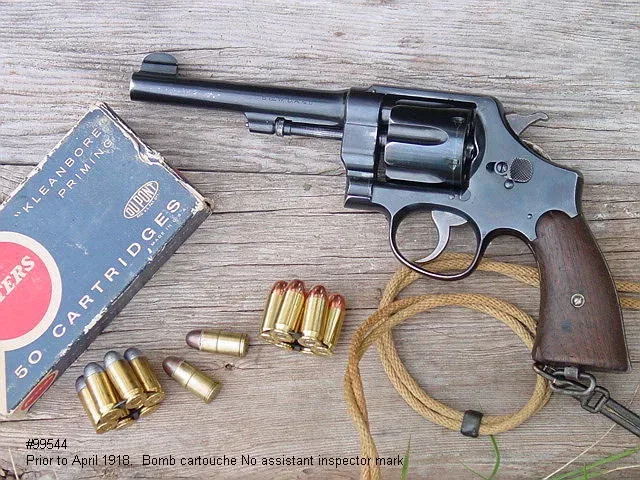
The Springfield Armory entered the 20th century as the primary development and production center for U.S. military small arms. Its engineers developed the Model 1903 Springfield — a bolt-action rifle chambered in 30-06 Springfield (a cartridge named for the Armory) — that became the standard U.S. infantry rifle through World War I and served alongside the M1 Garand in World War II. The '03 Springfield represented the Armory's final refinement of the bolt-action military rifle before semi-automatic technology overtook it.
Springfield Armory's Golden Age
The M1 Garand, designed by John Garand — a Canadian-born engineer who spent his career at the Springfield Armory — entered production there in 1936.
General George Patton later called the M1 Garand "the greatest battle implement ever devised."
The Armory produced over 600,000 M1 Garands before World War II production shifted to Winchester and International Harvester. Garand worked at the Armory from 1919 until his retirement in 1953, designing not just the M1 but also developing approaches to high-volume precision manufacturing that influenced production methods across American industry.
| Weapon | Designer | Production Period | Significance |
|---|---|---|---|
| Model 1903 Springfield | Springfield Armory | 1903-1949 | Standard infantry rifle through WWI |
| M1 Garand | John Garand | 1936-1957 | "Greatest battle implement ever devised" |
| Model 10 Revolver | Smith & Wesson | 1899-present | Standard police sidearm for decades |
World War II Production
During World War II, Smith & Wesson in Springfield produced the Model 10 (then called the Hand Ejector) and the Victory Model .38 Special revolvers for military and lend-lease contracts, along with the .38/200 variant for British forces. The company's production capacity was fully committed to war contracts through 1945. Harrington & Richardson and other Massachusetts manufacturers similarly shifted to military production — H&R produced the Reising submachine gun under contract, and various smaller shops contributed components to the broader war effort.
The End of an Era
The Springfield Armory closed in 1968 — a decision by the Defense Department that remains controversial among historians of American manufacturing and among the people of Springfield, who lost a major employer and a civic institution that had operated continuously for nearly two centuries. The closure came as part of a broader consolidation of military production, and the grounds became a National Historic Site managed by the National Park Service. The Armory's machine tools, technical records, and manufacturing legacy dispersed into the broader defense industry, but the physical plant ceased weapons production permanently.
A private company, Springfield Armory, Inc., was founded in Geneseo, Illinois, in 1974 — taking the historic name but having no operational connection to the original Massachusetts institution beyond the trademark. The original Springfield Armory's legacy is preserved at the National Historic Site on Armory Square in Springfield.
Regulatory Framework Emerges
On the regulatory side, Massachusetts moved consistently toward tighter controls through the 20th century. The state enacted a Firearms Identification Card system requiring residents to obtain a card before purchasing or possessing firearms or ammunition — a system that predated federal background check requirements by decades. By the 1990s, this framework was the foundation for more aggressive legislative action.
The political environment shifted sharply after a series of high-profile shootings. October 1989, a gunman killed a teacher and wounded five children at the Cleveland Elementary School in Stockton, California — a massacre carried out with a semi-automatic rifle. Massachusetts legislators moved quickly. The state enacted an assault weapons ban in 1998 that mirrored the federal Public Safety and Recreational Firearms Use Protection Act of 1994 (the federal assault weapons ban) but went further in several provisions.
The watershed year for Massachusetts firearms law was 1998. The state passed Chapter 180 of the Acts of 1998, a comprehensive overhaul that:
- Consolidated the Firearms Identification Card and License to Carry systems
- Required safety training for new license applicants
- Mandated trigger locks or secure storage for all firearms in homes with children under 18
- Established a Gun Control Act at the state level that went significantly beyond federal requirements
- Created a roster of approved handguns — the Massachusetts Approved Handgun Roster — restricting the sale of handguns not meeting state safety standards
The same legislation made Massachusetts the first state to require that all firearms be sold with a trigger lock or locked storage container.
Modern Era (2000–Present)edit
The federal assault weapons ban expired in September 2004, and manufacturers and dealers began offering previously restricted configurations nationwide. In Massachusetts, the state-level ban remained in force, but its enforcement was inconsistent. Dealers and manufacturers found ways to offer "Massachusetts compliant" versions of popular rifles — fixed stocks, bullet-button magazines, no flash hiders — that satisfied the letter of the law while preserving most of the rifle's function.
The Healey Enforcement Notice
That ambiguity ended — or at least became far more contested — on July 20, 2016, when Attorney General Maura Healey issued an enforcement notice declaring that the state's assault weapons ban applied not just to specific named models but to any weapon that is a "copy or duplicate" of a banned firearm. Healey argued that manufacturers had been exploiting a loophole and that her interpretation was the correct reading of the 1998 law. Gun dealers reported a massive surge in sales in the days before the notice took effect as customers rushed to purchase rifles that would be effectively unavailable afterward.
Bruen and Constitutional Challenges
The enforcement notice immediately drew legal challenges. Worman v. Healey reached the First Circuit Court of Appeals, which in 2018 upheld the state's assault weapons ban — ruling that the weapons covered were not protected by the Second Amendment under the applicable Heller framework because they were "weapons of war" not in common use for self-defense. The plaintiffs petitioned the Supreme Court, which declined to hear the case.
The Bruen decision in 2022 — New York State Rifle & Pistol Association v. Bruen — shifted the constitutional framework and reopened questions about Massachusetts law. Under Bruen, gun regulations must be consistent with the historical tradition of firearms regulation at the time of the founding, rather than passing a means-ends balancing test. That standard potentially undermines several Massachusetts statutes, and litigation has continued in federal courts challenging various aspects of the state's regulatory scheme.
Manufacturer Exodus
Smith & Wesson relocated its headquarters to Maryville, Tennessee, in 2023, citing the Massachusetts regulatory environment. The company's manufacturing operations followed, ending over 165 years of continuous production in Springfield. The move drew significant attention — both from gun rights advocates who framed it as a rejection of Massachusetts policy and from state officials who disputed that characterization. A small number of employees remained in Springfield, but the symbolic weight of the departure was considerable: the company that helped define Springfield's identity as a manufacturing city for a century and a half had left.
Kahr Arms also relocated from Massachusetts to Pike County, Pennsylvania, in 2015, citing regulatory burdens. The pattern of manufacturers leaving the state for more permissive regulatory environments became a recurring story through the 2010s and 2020s.
Massachusetts passed additional legislation in subsequent years. A 2014 law required gun owners to report lost or stolen firearms within 48 hours. The state's red flag law — an Extreme Risk Protection Order statute — took effect in 2018, allowing courts to temporarily remove firearms from individuals deemed to pose a danger to themselves or others. Massachusetts was among the earlier states to enact such a law.
In 2024, Governor Maura Healey — the former Attorney General who issued the 2016 enforcement notice — signed a comprehensive gun reform package that expanded the state's red flag law, tightened requirements for the Massachusetts Approved Handgun Roster, created new restrictions on ghost guns and untraceable firearms, and added requirements for dealers. It was the most significant update to Massachusetts gun law since 1998 and generated immediate legal challenges.
Major legislative and enforcement milestones in the modern era
Notable Figures & Manufacturersedit
| Figure | Years | Role | Key Contribution |
|---|---|---|---|
| Horace Smith | 1808-1893 | Co-founder S&W | Springfield Armory expertise |
| Daniel Wesson | 1825-1906 | Co-founder S&W | Mechanical innovation |
| John Garand | 1888-1974 | Springfield Armory engineer | M1 Garand designer |
| Ethan Allen | 1806-1871 | Inventor/manufacturer | Pepperbox mechanisms |
Horace Smith (1808–1893) and Daniel Wesson (1825–1906) built one of the most consequential firearms companies in American history in Springfield. Smith had worked at the Springfield Armory and brought that institutional knowledge of precision manufacturing to their partnership. Wesson's mechanical creativity complemented Smith's production expertise. The company they built together outlasted both of them by over a century.
John Garand (1888–1974) spent the productive decades of his career at the Springfield Armory, arriving in 1919 and staying until retirement. He received no royalties for the M1 Garand — having assigned his patent rights to the government as a condition of his employment — and was awarded a Medal of Merit in 1941. He continued working at the Armory in an advisory capacity into the 1960s.
Ethan Allen (1806–1871) — not the Revolutionary War figure — was one of the most prolific firearms inventors in 19th-century Massachusetts. He held patents on the pepperbox mechanism, various revolver designs, and manufacturing processes. His Grafton and later Worcester operations produced firearms by the hundreds of thousands.
Gilbert Harrington and William Richardson built Harrington & Richardson into one of the largest affordable firearms manufacturers in the country. H&R's Worcester plant operated for over a century, and the company's single-shot rifles and break-open shotguns remain common in collections and at rural gun stores nationwide. H&R 1871, a successor company, continued operating in Gardner, Massachusetts, before production eventually shifted.
Savage Arms, though founded in New York, established its primary manufacturing presence in Chicopee Falls, Massachusetts, in 1915 — directly across the Connecticut River from Springfield. The Chicopee Falls plant produced Savage rifles and shotguns through much of the 20th century, including the Model 99 lever-action, the Model 110 bolt-action (one of the best-selling hunting rifles in American history), and significant military contracts. Savage later relocated manufacturing to Suffield, Connecticut, but its Massachusetts roots are integral to its history.
Iver Johnson Arms & Cycle Works in Fitchburg and Worcester was for decades a leading producer of inexpensive revolvers marketed to working-class buyers. Their "Hammer the Hammer" advertising campaign — demonstrating the safety of their transfer bar mechanism — was one of the most recognizable firearms advertisements of the late 19th century. An Iver Johnson revolver was the weapon used to assassinate Senator Robert F. Kennedy in 1968, a fact that brought the company unwanted notoriety and contributed to the political environment that produced the Gun Control Act of 1968.
Current Legal Landscapeedit
Massachusetts operates under one of the most restrictive firearms regulatory frameworks in the country. Here is what that framework actually requires:
Licensing Requirements
| License Type | Age Requirement | Allows Possession Of | Issuing Authority |
|---|---|---|---|
| License to Carry (LTC) | 21+ | All firearms, including handguns and large-capacity long guns | Local police chief |
| Firearms ID Card (FID) | 18+ | Non-large-capacity rifles and shotguns only | Local police chief |
A License to Carry (LTC) is required to purchase, possess, or carry any firearm, including handguns and "large capacity" rifles and shotguns. LTC applicants must be 21 or older.
A Firearms Identification Card (FID) allows possession of non-large-capacity rifles and shotguns. FID applicants must be 18 or older.
Both licenses are issued by the local police chief, who retains discretion to deny or restrict licenses for reasons beyond the statutory disqualifiers — a "may issue" structure that Bruen has put under significant legal pressure.
There is no constitutional carry in Massachusetts. Unlicensed carry, open or concealed, is a felony.
Prohibited Weapons and Devices
- The Massachusetts Assault Weapons Ban prohibits sale, transfer, or possession of assault weapons as defined by state law
- "Large capacity" feeding devices (magazines holding more than 10 rounds) manufactured after September 13, 1994, are prohibited
- Dealers sell "Massachusetts compliant" configurations of many popular rifles
Handguns sold by dealers must appear on the Massachusetts Approved Firearms Roster. The roster requires handguns to meet specific safety standards including a loaded chamber indicator, a magazine disconnect, and other features.
Many modern handguns — including several popular striker-fired pistols — do not meet roster requirements and cannot be sold new by dealers, though they can be transferred between private parties under certain conditions. This restriction is also under active legal challenge post-Bruen.
Storage and Transfer Rules
All firearms must be stored with a trigger lock or in a locked container when not under the direct control of the owner.
Negligent storage resulting in access by a minor is a criminal offense.
Massachusetts requires background checks for all firearm transfers, including private party sales — not just dealer sales.
The 2024 legislation significantly tightened restrictions on unserialized firearms, requiring serialization of home-built firearms and restricting the sale of unfinished frames and receivers.
Post-Bruen Legal Challenges
The Bruen decision's history-and-tradition test has generated ongoing federal litigation challenging multiple aspects of Massachusetts law, including the may-issue licensing structure and the handgun roster. As of early 2026, no Massachusetts statute has been struck down as a direct result of Bruen, but several cases remain pending in the First Circuit.
The BGC Takeedit
Massachusetts is genuinely two different places when it comes to gun culture, and you need to understand that to understand why the legal landscape looks the way it does.
Western Massachusetts — the Pioneer Valley, the Berkshires, the rural towns scattered between Springfield and the New York border — has a gun culture that would be recognizable in any rural state. People hunt deer, turkey, and bear. They shoot clays at the West Springfield Sportsmen's Club and at dozens of similar clubs across the region. They keep guns in the house because they live 20 minutes from the nearest police response. The NRA has active members here, and the Gun Owners' Action League (GOAL) — Massachusetts's state-level firearms advocacy organization, founded in 1974 — draws most of its active membership from these communities.
Eastern Massachusetts — Boston, Cambridge, Worcester, the suburban ring — is a different universe. The political culture is progressive, gun ownership rates are lower, and the instinct of the legislature reflects that constituency. When Boston legislators write gun laws, they're writing them for Boston. The result is a regulatory framework designed for an urban environment that gets applied uniformly to the guy in Worthington who needs a rifle to put down a sick calf.
The LTC's "may issue" structure deserves particular scrutiny. In practice, what this means is that your relationship with your local police chief determines whether you can carry a firearm. In rural towns, chiefs generally issue without restriction. In some cities — Boston historically prominent among them — issuing authorities have applied restrictions that effectively prohibit carry for most applicants who aren't connected or persistent. Bruen targeted exactly this kind of discretionary denial, and the legal pressure on Massachusetts's licensing structure is real and building.
The departure of Smith & Wesson to Tennessee in 2023 was more than a business story. A company that had operated in Springfield since 1856 — that had armed Union soldiers, supplied Allied forces in two world wars, and built generations of Springfield families into the middle class — concluded that the regulatory and political environment had made Massachusetts untenable for a firearms manufacturer. Whether you think that's a reasonable business decision or a dramatic overreaction probably maps pretty closely onto your broader political views. But the manufacturing jobs are gone either way.
GOAL remains an effective advocacy organization by the standards of a blue state. They've stopped worse bills than they've passed, which is about the realistic ceiling for gun rights advocacy in a legislature with supermajority Democratic control. Their Firearms Records Bureau monitoring and their ongoing support for Bruen-related litigation are the practical fronts of that work right now.
For a gun owner moving to Massachusetts: get an LTC, not an FID, even if you only own rifles. The FID's restrictions will limit you in ways you won't anticipate. Apply in the town where you live, not where you work. Take the required safety course before you apply — not because it'll teach you much if you're experienced, but because showing up prepared signals to the issuing authority that you're serious. Budget for the 60-day statutory processing period to actually take 90 to 120 days in many jurisdictions.
For a collector or competitive shooter: Massachusetts has a robust competitive shooting community despite its reputation. The Wrentham Sportsmen's Association, Harvard Sportsmen's Club, and numerous other clubs host matches, and GOAL coordinates a full competitive calendar. IDPA, USPSA, and precision rifle competition are all active here. You'll have to navigate the handgun roster for any new dealer purchase, but existing guns you own are grandfathered for possession.
Massachusetts earned its place at the center of American firearms history — from the shots at Concord Bridge to the Armory that built the M1 Garand to the company that gave American law enforcement the Model 10 for half a century. That history doesn't disappear because the politics have moved in a particular direction. It just means the tension between the founding-era tradition of the armed citizen and the modern regulatory state is more visible here than almost anywhere else in the country.
Referencesedit
- Library of Congress Research Guide: American Firearms and Their Makers — General Works
- The Trace: A Timeline of American Gun History (June 2025)
- American Revolution Institute: A Revolution in Arms: Weapons in the War for Independence (Exhibition, 2018–2019)
- National Park Service: Springfield Armory National Historic Site — Historical Overview
- Massachusetts General Laws Chapter 140, §§ 121–131P (Firearms statutes)
- Massachusetts Acts of 1998, Chapter 180 (Comprehensive firearms reform)
- Worman v. Healey, 922 F.3d 26 (1st Cir. 2019)
- New York State Rifle & Pistol Association v. Bruen, 597 U.S. 1 (2022)
- Massachusetts Attorney General Enforcement Notice: Assault Weapons, July 20, 2016
- Gun Owners' Action League (GOAL): Legislative History Archive
- Smith & Wesson Company History, Springfield Armory NHS Archives
- H&R 1871 Corporate History Documentation
- Savage Arms Company Historical Records, Chicopee Falls
- Iver Johnson Arms & Cycle Works — Historical Firearms Society Documentation
Last Updated: February 24, 2026
- Quail Creek Plantation(Okeechobee, FL)
- 2aHawaii(Honolulu, HI)
- Boston Firearms(Everett, MA)
- Safeshoot(Kingston, NY)
Loading comments...