State Details
Pennsylvania
Overview | |
|---|---|
State | Pennsylvania (PA) |
Capital | Harrisburg |
Statehood | 1787 |
Population | 13,002,700 |
Gun Ownership | 40.7% |
Active FFLs | 2,162 |
Carry Laws | |
Constitutional Carry | No |
Open Carry | Yes |
CCW Permit Available | Yes |
Permit Reciprocity | 25+ states |
Self-Defense | |
Castle Doctrine | Yes |
Stand Your Ground | Yes |
Duty to Retreat | No |
Regulations | |
State Preemption | Yes |
Red Flag / ERPO | No |
Waiting Period | None |
Universal BGC | No |
NFA Items | Yes |
Assault Weapons Ban | No |
Magazine Limit | None |
Key Legislation | |
| |
Notable Manufacturers | |
| |
Pennsylvania Firearms History: From the Pennsylvania Rifle to Modern Gun Rights
Reference article
From The Boise Gun Club Handbook
Updated August 15, 2026. The law moved twice since this article was written. The $200 making and transfer tax on suppressors, SBRs, SBSs and AOWs was eliminated effective January 1, 2026 by the One Big Beautiful Bill Act. Then on August 5, 2026 a federal court in Silencer Shop Foundation v. ATF struck down the NFA registration and approval requirements for those same items, and that injunction took effect August 13. It covers only the plaintiffs, their members and their customers. Living in a plaintiff state does not make you covered. Machine guns and destructive devices are unchanged. Read the current guide: NFA Items in 2026: What Actually Changed.
Overviewedit
If you want to understand where American gun culture came from, you start in Pennsylvania. Not metaphorically — literally. The Pennsylvania long rifle form that defined frontier America was born in Lancaster County workshops. The first state constitution to explicitly protect the right to bear arms was written in Philadelphia. The pocket pistol that changed personal defense was manufactured on Quarry Street in that same city. And the bloodiest battle ever fought on American soil happened on Pennsylvania farmland, consuming firearms by the hundreds of thousands.
Pennsylvania's firearms story is not a backdrop to American history — it is American history.
The state's German immigrant gunsmiths, its Quaker-complicated relationship with military arms, its industrial muscle during two world wars, and its modern political fault line between a heavily armed rural interior and a gun-control-minded Philadelphia all make it one of the most consequential states in the country for understanding how guns became woven into American life.
This is also a state with genuine internal tension. The same legislature that has blocked Philadelphia's gun ordinances for decades has failed, repeatedly, to pass constitutional carry. Gun owners here navigate a patchwork of cultural attitudes as much as a patchwork of laws.
Colonial & Frontier Eraedit
When William Penn received his charter in 1681 and began settling his colony, he faced a structural problem that complicated gun policy from the start: his Quaker faith opposed war, but his frontier colony needed armed settlers to survive. Penn himself was no pacifist absolutist — he understood that the colony's survival depended on men who could shoot — but the Society of Friends' influence meant Pennsylvania's early relationship with firearms manufacture and militia organization was more complicated than in Virginia or Massachusetts.
The Quaker Dilemma
That tension didn't slow down the gunsmiths, though. Beginning around the 1710s and 1720s, German and Swiss immigrants settled heavily in Lancaster County and the surrounding Pennsylvania Dutch Country.
Many brought gunsmithing skills from their home regions, where the Jäger rifle was the standard hunting arm. What they built in Pennsylvania over the next several decades was something entirely new.
German Gunsmith Innovation
The Pennsylvania long rifle — widely but incorrectly called the Kentucky rifle in popular culture — emerged from these Lancaster-area shops as a deliberate adaptation to American conditions. Where the Jäger was short-barreled, large-caliber, and suited for close European hunting, the Pennsylvania gunsmiths made distinctive innovations:
- Stretched barrel to 40–48 inches for accuracy
- Reduced caliber to .40–.50 for economy
- Shaped distinctive drooping crescent buttstock
- Achieved 200+ yard consistent accuracy
- Used less lead and powder per shot
| Feature | European Jäger | Pennsylvania Long Rifle |
|---|---|---|
| Barrel Length | 24-30 inches | 40-48 inches |
| Caliber | .60-.75 caliber | .40-.50 caliber |
| Effective Range | 100-150 yards | 200+ yards |
| Stock Profile | Straight, heavy | Drooping crescent butt |
| Powder/Lead Use | High consumption | Economical |
| Primary Purpose | Close European hunting | American frontier survival |
Lancaster, York, and Reading became the centers of this trade. Gunsmiths like Martin Meylin, who operated a rifle works near Willow Street in Lancaster County as early as the 1710s, are among the earliest documented. By mid-century, dozens of shops were operating across the region, each producing rifles that were signed, decorated, and finished with a craftsmanship that reflected individual gunmaker identity. The brass patchbox on the right side of the stock — functional storage for greased patches used to seat the ball — became increasingly ornate, a signature element that collectors still use to attribute rifles to specific makers.
Frontier Conflicts
These rifles fed frontier Pennsylvania. Hunters took deer, elk, and bear. Settlers defended homesteads during Pontiac's War (1763), when attacks on the Pennsylvania frontier produced what became known as the Paxton Boys crisis — a group of Scots-Irish settlers from Paxton Township who massacred peaceful Conestoga Indians in December 1763 and then marched on Philadelphia, forcing Benjamin Franklin into an awkward role as negotiator. The episode exposed the deep divide between the armed, Scots-Irish frontier and the Quaker-dominated Philadelphia establishment — a divide that has never fully closed.
Pennsylvania's militia situation going into the Revolution was, by some historical accounts, genuinely troubled. A 2014 Journal of the American Revolution article titled A Want of Arms in Pennsylvania documented that the colony had fewer military-quality firearms per capita than most other colonies at the war's outset. Quaker resistance to both militia service and arms manufacture had real effects on military readiness. The Pennsylvania Assembly was slow to act on arming its population compared to New England. When the shooting started, Pennsylvania's Committee of Safety found itself scrambling.
Revolutionary War & Constitutional Foundationedit
Despite the pre-war shortage, Pennsylvania became one of the most important arms-producing colonies once the Revolution began in earnest. The Committee of Safety, established in 1775, immediately began contracting with local gunsmiths to produce military muskets and rifles. Lancaster County alone had enough skilled gunmakers to make it the primary domestic production center for Continental firearms.
The Henry family of Boulton, Pennsylvania — near Nazareth in Northampton County — represents the most documented example of this war-era production. William Henry Sr. had been an armorer during the French and Indian War and was already established as a gunsmith before the Revolution. His operations, and those of his sons, expanded to supply Continental forces. By 1811, William Henry III established what was called "The American Rifle Manufactory" in Philadelphia as a separate production facility — one of the earliest attempts at consolidated firearms manufacturing in the state.
Pennsylvania rifle companies fighting under Continental Army command made a genuine tactical impression. Daniel Morgan's Virginia rifle corps included many Pennsylvania-trained riflemen, and their performance at Saratoga in 1777 — picking off British officers and artillerists at ranges that smoothbore muskets couldn't touch — demonstrated what the Pennsylvania long rifle could do in military hands. General George Washington himself requested rifle companies early in the war, specifically citing their potential to demoralize British officers who weren't accustomed to being targeted individually at long range.
But Pennsylvania's most lasting contribution to firearms history from this era was not a weapon — it was a document. The Pennsylvania Constitution of 1776, written by a convention in Philadelphia and heavily influenced by Benjamin Franklin and James Cannon, contained in its Declaration of Rights this language:
That the people have a right to bear arms for the defence of themselves and the state. — Pennsylvania Constitution of 1776
This was the first explicit state constitutional protection for the right to bear arms in American history, predating the federal Second Amendment by fifteen years. Its phrasing — notably including self-defense alongside state defense — directly influenced the debate that produced the Second Amendment in 1791. When scholars argue about the original meaning of the Second Amendment, Pennsylvania's 1776 constitution is primary evidence.
Pennsylvania's foundational role in American gun rights constitutional framework
Philadelphia was also where the Constitutional Convention of 1787 met, and where the First Congress debated and passed the Bill of Rights. The arguments over what became the Second Amendment were shaped significantly by Pennsylvania Anti-Federalists, who objected that the proposed constitution gave the federal government too much control over the militia and too little protection for individual arms-bearing. The Pennsylvania Minority Report of 1787, written by dissenting delegates, explicitly proposed language protecting individual arms-bearing — language that Madison later incorporated into the Second Amendment drafting process.
19th Century: Statehood, Industry & Civil Waredit
Pennsylvania entered the 19th century already the young republic's most industrially capable state, and that capacity quickly extended to firearms. Henry Deringer Jr. — born in Easton, Pennsylvania in 1786 — apprenticed as a gunsmith and eventually established himself in Philadelphia, where he produced flintlock rifles on U.S. government contract as early as 1810. He made rifles, muskets, and pistols for government orders for decades, but his lasting fame came from a small percussion pocket pistol he began producing in the 1820s and 1830s.
The Deringer Legacy
The Deringer pocket pistol — a short-barreled, large-bore percussion pistol optimized for concealment — became wildly popular. So popular, in fact, that competing manufacturers immediately produced copies, spelling his name "derringer" with a second 'r' to avoid trademark liability. When John Wilkes Booth used a single-shot pistol to assassinate President Abraham Lincoln at Ford's Theatre on April 14, 1865, he used a Philadelphia Deringer. Deringer's name became permanently embedded in American vocabulary as a generic term for any small, concealable pistol.
The Frankford Arsenal, established in Philadelphia in 1816, became one of the most significant military manufacturing facilities in American history. Located in the Frankford neighborhood of northeastern Philadelphia, the arsenal focused primarily on ammunition production and testing rather than complete firearms. By the Civil War era, it was producing millions of rounds of small arms ammunition annually. The facility's work on cartridge design and standardization throughout the 19th century was foundational — Frankford conducted the testing that established many of the military cartridge standards that fed American rifles through two world wars.
Civil War Arsenal
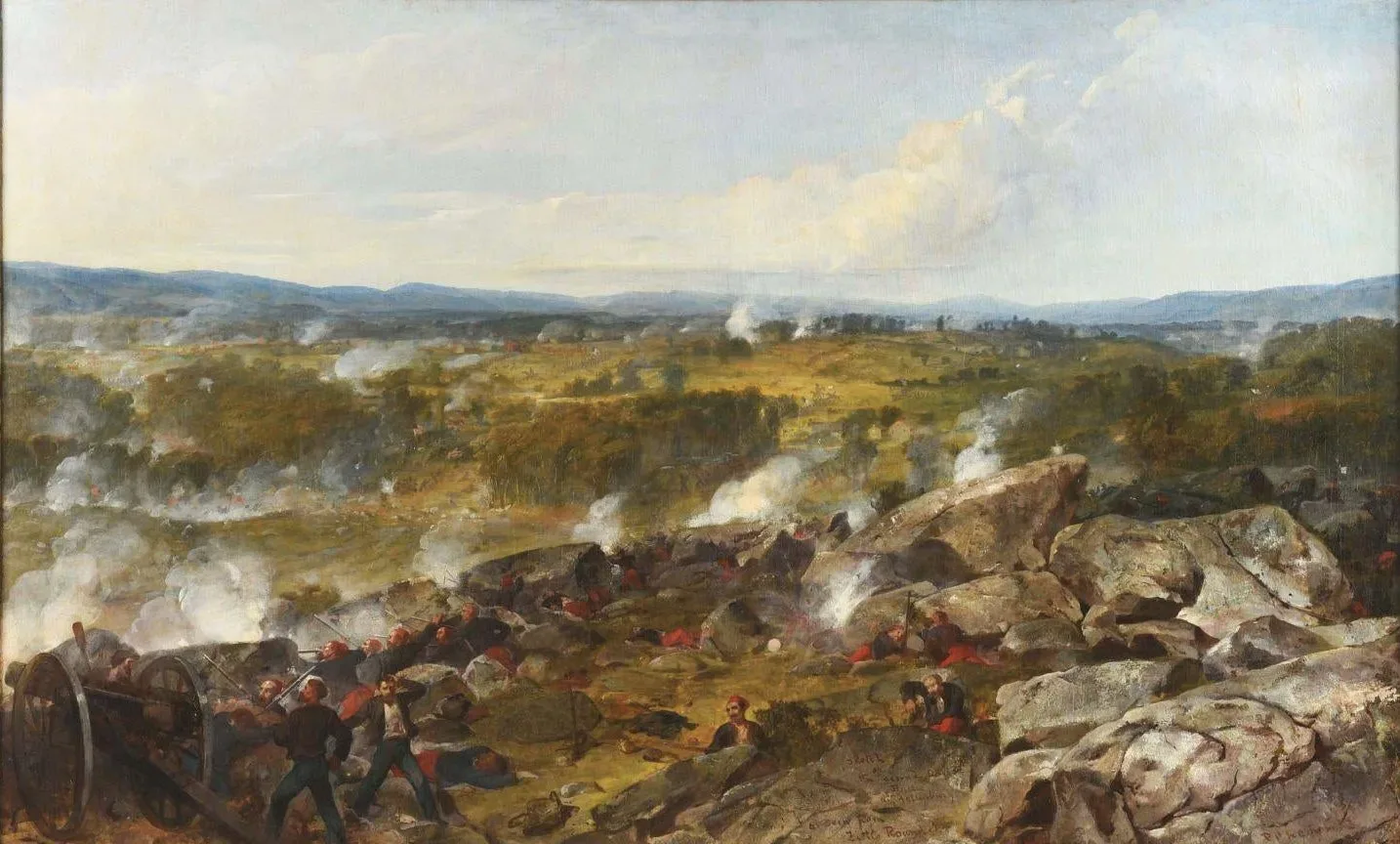
The Battle of Gettysburg, July 1–3, 1863, fought on south-central Pennsylvania farmland, remains the largest battle ever fought in North America. Roughly 165,000 soldiers engaged over three days, expending an almost incomprehensible quantity of ammunition.
Post-battle collection of arms from the field recovered more than 37,000 rifles and muskets — most of them loaded, many loaded multiple times by soldiers who had been too rattled to fire before reloading. The variety of arms recovered at Gettysburg documents the full spectrum of Union and Confederate firearms of the era: Springfield Model 1861 rifled muskets predominated for Union troops; Confederate forces carried a mix of Springfields, Enfield Pattern 1853 rifles imported from Britain, and whatever else could be sourced.
| Battle Statistics | Numbers |
|---|---|
| Total Engaged | ~165,000 soldiers |
| Duration | July 1-3, 1863 |
| Firearms Recovered | 37,000+ rifles/muskets |
| Primary Union Arm | Springfield Model 1861 |
| Confederate Arms | Mixed: Springfield, Enfield P1853, various |
| Pennsylvania Regiments | 215 infantry, 37 cavalry, 13 artillery |
Pennsylvania industry fed the Union war machine broadly. Philadelphia and Pittsburgh manufacturers produced everything from artillery to edged weapons. The Reading Iron Works and other Pennsylvania foundries produced cannon and shot. Pennsylvania also contributed to Union service:
- 215 infantry regiments
- 37 cavalry regiments
- 13 artillery regiments
- More men than any other Northern state
Most of them eventually armed with state-of-the-art rifled muskets drawn from federal arsenals.
In the postwar period, Pennsylvania's role in the national firearms industry declined relative to New England, where Colt, Winchester, Smith & Wesson, and Remington (based in upstate New York) dominated. But the state remained significant as an ammunition and components producer, and Philadelphia's gunsmithing trade continued serving the Mid-Atlantic market.
20th Century: Wars, Industry & Regulationedit
Industrial War Production
The Frankford Arsenal hit its stride in the 20th century. During World War I, it massively expanded production of .30-06 Springfield ammunition — the standard U.S. rifle cartridge — and conducted developmental work on machine gun ammunition feed systems. During World War II, the arsenal employed thousands of workers producing ammunition at industrial scale. Its ordnance engineering work during the Cold War era included development and testing of the 7.62×51mm NATO cartridge in the early 1950s, which became the standard NATO round and still feeds the M14, M60, and numerous other military weapons. The arsenal continued operating until 1977, when the Army closed it as part of a post-Vietnam consolidation. The site is now Frankford Arsenal Business Complex, still bearing the name if not the function.
Pennsylvania also hosted significant contributions to small arms development in the mid-20th century. Maremont Corporation's Bridgeport operation and related Pennsylvania-based ordnance contractors contributed to machine gun and automatic weapons development. The Army's Frankford Arsenal engineers were directly involved in the SALVO program of the 1950s, which explored small-caliber, high-velocity rifle concepts — work that fed directly into the development of what became the 5.56×45mm cartridge and eventually the M16 rifle.
Modern Regulation Framework
| Pennsylvania Firearms Law Timeline | Year | Legislation |
|---|---|---|
| Federal Gun Control Act | 1968 | Federal dealer licensing, prohibited persons |
| State Preemption | 1974 | Act 78 - prohibited local gun ordinances |
| State Background Checks | 1989 | PICS system (predated federal NICS) |
| Federal NICS Launch | 1998 | National instant check system |
| Preemption Enforcement | 2014 | Private lawsuit authority added |
The Gun Control Act of 1968 imposed federal dealer licensing requirements and prohibited-person restrictions nationwide, but Pennsylvania's response at the state level was more significant than most gun owners realize. In 1974, Pennsylvania enacted Act 78, establishing statewide firearms preemption — meaning that local governments were prohibited from enacting firearms ordinances stricter or broader than state law. This was a genuinely consequential piece of legislation for a state that contains both Philadelphia and vast rural counties where gun ownership is simply assumed. Without preemption, Philadelphia's city government would almost certainly have enacted ordinances dramatically restricting firearms long before the 1970s ended.
Pennsylvania also established its own instant check system for handgun purchases in 1989, predating the federal NICS system (which went live in 1998) by nearly a decade. The Pennsylvania Instant Check System (PICS), administered by the Pennsylvania State Police, runs checks on all firearm purchases — not just handguns — through state databases that include records the federal system sometimes misses. This means Pennsylvania gun buyers go through a state check even when the federal NICS system would otherwise apply. It also means that Pennsylvania does not fully honor the federal NICS Improvement Amendments Act provision allowing sales to proceed after three business days if a check is delayed — Pennsylvania holds sales until the check clears, period.
Modern Era (2000–Present)edit
The Philadelphia Preemption Wars
The defining legal and political fight in modern Pennsylvania firearms history has been the battle over Philadelphia's gun ordinances versus state preemption. Starting around 2008 and accelerating through the 2010s, Philadelphia's city council passed multiple ordinances that directly conflicted with state preemption: requiring lost-or-stolen firearm reporting, banning so-called assault weapons, and restricting certain sales practices. Pennsylvania courts consistently struck these ordinances down on preemption grounds.
The recurring cycle of Philadelphia gun ordinances vs. state preemption
In 2014, the Pennsylvania General Assembly amended the preemption statute to allow individuals with standing — not just the state — to sue municipalities that violated preemption, and to allow recovery of attorney's fees. Philadelphia immediately challenged the amendment's constitutionality. The resulting litigation ran through the courts for years. The Commonwealth Court and Pennsylvania Supreme Court issued rulings that refined (and in some respects limited) the enforcement mechanism, but the core preemption framework survived. As of early 2026, Philadelphia cannot legally enforce firearms ordinances stricter than state law, though the city's political establishment continues to test the boundaries.
Castle Doctrine and Self-Defense
The castle doctrine came to Pennsylvania through Act 10 of 2011, signed by Governor Tom Corbett. Pennsylvania law now explicitly states that a person in their home, vehicle, or any place they have a legal right to be has no duty to retreat before using force in self-defense. The law also provides civil immunity for justified defensive use of force — you can't be successfully sued by the person you defended yourself against, or their estate, if criminal charges were not filed or resulted in acquittal.
The Constitutional Carry Stalemate
Constitutional carry — permitless concealed carry — has been a recurring legislative fight. Bills have passed the General Assembly multiple times, only to be vetoed by Democratic governors. Governor Tom Wolf vetoed constitutional carry legislation in 2021. Governor Josh Shapiro, elected in 2022, has been equally clear that he would veto similar legislation. Given that Pennsylvania's governorship has alternated between parties and that Shapiro won in a state Trump carried in 2020 by emphasizing his support for gun rights while still opposing permitless carry, the political picture is genuinely complicated. As of early 2026, Pennsylvania requires a License to Carry Firearms (LTCF) for concealed carry, and that is unlikely to change under Shapiro's administration.
| Pennsylvania LTCF Requirements | Details |
|---|---|
| Issuing Authority | County Sheriff |
| Standard | Shall-issue |
| Cost | $20 |
| Validity | 5 years |
| Age Requirement | 21 years old |
| Background Check | Required through PICS |
| Reciprocity | Agreements with multiple states |
The License to Carry Firearms in Pennsylvania is issued by county sheriffs, is shall-issue (the sheriff must issue it if you meet the legal qualifications — there's no discretionary denial based on "good cause" or similar), costs $20 for five years, and is recognized by a substantial number of other states. Pennsylvania reciprocally recognizes licenses from states with which it has agreements, though the list has shifted over the years as attorneys general have revised reciprocity agreements.
Pennsylvania's background check system became a flashpoint in 2019 after the Tree of Life synagogue shooting in Pittsburgh on October 27, 2018 — the deadliest antisemitic attack in American history, in which eleven people were killed. The shooter had passed a federal NICS check because his disqualifying information had not been properly reported to federal databases. Pittsburgh's city council responded by passing ordinances restricting semi-automatic rifles and bump stocks. Those ordinances were immediately challenged and struck down on preemption grounds. The episode intensified both the preemption debate and calls for improved mental health reporting to background check systems.
Suppressor ownership is legal in Pennsylvania under federal NFA rules — residents can own suppressors after completing the federal Form 4 process and paying the $200 tax. Pennsylvania has no additional state restrictions on NFA items beyond federal law.
Short-barreled rifles and shotguns are legal to own in Pennsylvania, again subject to federal NFA compliance. There is no state-level registration requirement beyond the federal process.
Notable Figures & Manufacturersedit
Colonial Era Masters
Henry Deringer Jr. (1786–1868) remains Pennsylvania's most consequential individual gunmaker by name recognition alone. His Philadelphia shop on Quarry Street produced firearms for roughly five decades. The irony of his legacy is that the pistol most associated with his name — the small percussion pocket pistol — was so widely copied that he spent years in litigation trying to protect his brand, largely unsuccessfully. Every "derringer" sold today carries a misspelling of his name coined by competitors.
The Henry family of Northampton County — William Henry Sr., Jr., and III — operated one of the longest-running gunsmithing dynasties in early American history. Their Boulton-area operations supplied Revolutionary War firearms and continued producing arms into the early 19th century. The 2006 American Society of Arms Collectors monograph on the Henrys documented their transition from craft gunsmithing to proto-industrial production, including the Philadelphia assembly shop William Henry III established in 1811.
Martin Meylin (c. 1680–1749), a Swiss Mennonite gunsmith who settled in Lancaster County, is among the earliest documented makers of what became the Pennsylvania long rifle. His rifle works near Willow Street in Lancaster County represents the geographic origin point of the form. The Meylin Gun Works site is a Pennsylvania historical landmark.
Peter Gonter, John Moll, John Newcomer, and dozens of other Lancaster-area gunsmiths of the 18th century produced the rifles that defined American frontier capability. Their work is documented in collections at the Philadelphia Museum of Art, the Pennsylvania State Museum in Harrisburg, and the Lancaster County Historical Society.
Modern Manufacturing
Keystone Sporting Arms, based in Milton, Pennsylvania, manufactures the Crickett and Chipmunk lines of single-shot .22 LR rifles marketed to youth shooters. They produce a significant volume of first rifles — the guns that introduce a lot of Pennsylvania kids (and kids across the country) to shooting. The company has operated in Milton since the 1990s.
Wilson Combat does not have Pennsylvania roots, but Nighthawk Custom and other premium 1911 manufacturers have drawn on Pennsylvania's gunsmithing tradition through their workforce. More directly Pennsylvania-connected: Lanco Tactical and several smaller custom shops in the Lancaster-York corridor continue a gunsmithing tradition that traces directly back to the 18th century German immigrant craftsmen.
Olympic Arms and other AR-pattern manufacturers have had Pennsylvania distribution relationships, but the state's modern manufacturing footprint in complete firearms is modest compared to its historical significance. Pennsylvania's current contribution to the firearms industry is more in components, ammunition, and accessories than complete weapons — a reflection of how the industry consolidated around New England and Southern manufacturers over the 20th century.
The Frankford Arsenal, even after its 1977 closure as a military facility, left a legacy in the commercial ammunition industry. Several of the engineers and metallurgists who worked there ended up at commercial ammunition companies, and the standards the arsenal established for cartridge dimensions and pressure specifications remain the foundation of SAAMI (Sporting Arms and Ammunition Manufacturers' Institute) standards today.
Current Legal Landscapeedit
Pennsylvania operates under a shall-issue concealed carry system with no constitutional carry as of early 2026. Here's the practical picture:
| Current Pennsylvania Gun Laws | Status |
|---|---|
| Concealed Carry | LTCF required ($20, 5 years) |
| Open Carry | Legal statewide (except Philadelphia) |
| Constitutional Carry | Not enacted (vetoed repeatedly) |
| Background Checks | PICS system for all dealer sales |
| Private Sales | Long guns: no check required |
| Handgun Private Sales | Must use dealer/sheriff for check |
| NFA Items | Legal with federal compliance |
| Castle Doctrine | Yes (Act 10 of 2011) |
| Assault Weapons Ban | None (preemption blocks local bans) |
| Red Flag Laws | Not enacted |
NFA Items
- Suppressors, SBRs, SBSs, and machine guns manufactured before May 19, 1986 are legal to own subject to federal NFA compliance
- No additional state registration beyond federal requirements
Castle Doctrine & Stand Your Ground
- Act 10 of 2011 codified castle doctrine and removed duty to retreat in any place where a person has a legal right to be
- Civil immunity for justified defensive use of force
Preemption
- Act 78 of 1974 establishes state preemption of local firearms ordinances
- 2014 amendments allow private parties with standing to sue municipalities for preemption violations and recover attorney's fees
- Philadelphia continues to periodically test preemption boundaries through ordinances and enforcement actions
Assault Weapons / Magazine Capacity
- No state-level assault weapons ban
- No state-level magazine capacity restriction
- Philadelphia's attempted bans have been struck down on preemption grounds
Red Flag / ERPO
- Pennsylvania does not have an Extreme Risk Protection Order (ERPO) law as of early 2026
- Governor Shapiro has expressed support for ERPO legislation; the Republican-controlled legislature has blocked it
Age Requirements
- Federal minimums apply: 18 for long gun purchases from dealers, 21 for handgun purchases from dealers
- LTCF requires applicant to be 21
The BGC Takeedit
Pennsylvania is the most historically significant state in American firearms history that gun owners outside the region consistently underestimate. They know the Kentucky rifle — they just don't know it came from Lancaster County. They know the derringer — they just don't know Deringer was a Philadelphian. They know the Second Amendment — they don't know Pennsylvania's 1776 constitution got there first.
Pennsylvania is the most historically significant state in American firearms history that gun owners outside the region consistently underestimate.
The on-the-ground reality for Pennsylvania gun owners in 2026 is genuinely mixed. If you live in Centre County, Butler County, or anywhere in the vast rural middle of the state, you're basically fine. LTCF is cheap and easy to get, sheriffs process them without hassle, open carry is a non-event, and the culture is gun-normal in a way that would feel familiar to anyone from Idaho or Tennessee.
Hunting — deer especially, but also turkey, bear, and small game — is deeply embedded in Pennsylvania's rural identity. The first day of deer season has historically triggered significant school absenteeism in rural districts, and many schools in northern and central Pennsylvania simply canceled classes rather than fight it.
If you live in or near Philadelphia, it's a different world. The city's political establishment is openly hostile to gun ownership in a way that feels more like New York or Chicago than Pennsylvania. The fact that their ordinances keep getting struck down on preemption grounds doesn't make the cultural hostility any less real. Pittsburgh is somewhere in between — politically blue and increasingly so, but with a surrounding metro area that still has strong hunting and shooting culture.
The constitutional carry situation is genuinely frustrating for Pennsylvania gun owners who pay attention. This is a state that voted for Trump in 2016 and came within a few points in 2020 and 2024, a state with Republican legislative supermajorities in some recent sessions, and yet it can't pass permitless carry because the governorship keeps going Democratic and the Democrats who win statewide do so partly by running as moderate on guns while still vetoing the legislation.
Shapiro's political positioning — supporting some gun rights while opposing constitutional carry and supporting red flag laws — is a preview of how Democratic politicians in competitive states will handle this issue going forward.
The Tree of Life aftermath showed both sides of Pennsylvania's gun debate at their worst. Pittsburgh passed ordinances that everyone knew were preempted before the ink dried. Gun rights advocates sued immediately. Nobody got anything they actually wanted in terms of policy — the legal fight consumed energy that could have gone toward actually improving mental health reporting to background check systems, which was the actual failure that allowed the shooter to pass his check. That pattern — symbolic legislation that generates litigation instead of results — has defined too much of Pennsylvania's recent firearms policy debate.
For competition shooters, Pennsylvania has a strong infrastructure. Camp Perry draws Ohio competitors, but Pennsylvania has its own tradition through the National Rifle Association's affiliated clubs, IDPA and USPSA clubs throughout the state, and a robust steel challenge and 3-gun scene in the central and western regions. The Pennsylvania State Police runs a respectable firearms qualification and training program, and private training infrastructure is solid.
Bottom line: Pennsylvania is a state where the history is richer than almost anywhere else in the country, the legal environment is workable if not ideal, and the political future is genuinely uncertain. The rural-urban split here is sharper than in most states, and the firearms issue is one of the clearest expressions of it. If you're a gun owner moving to Pennsylvania, pick your county carefully — not because the laws change (preemption means they don't), but because the culture absolutely does.
Referencesedit
- Pennsylvania Constitution of 1776, Declaration of Rights, Section XIII
- Pennsylvania Firearms Act, 18 Pa. C.S. § 6101 et seq.
- Pennsylvania Act 78 of 1974 (Firearms Preemption)
- Pennsylvania Act 10 of 2011 (Castle Doctrine / Stand Your Ground)
- Vine v. Commonwealth of Pennsylvania, Pennsylvania Supreme Court (2021)
- City of Philadelphia v. Commonwealth of Pennsylvania, Commonwealth Court (2014–2020 litigation)
- Kauffman, Henry J. The Pennsylvania-Kentucky Rifle. Stackpole Books, 1960.
- Kindig, Joe K. Jr. Thoughts on the Kentucky Rifle in its Golden Age. Trimmer, 1960.
- Whisker, James B. The Gunsmith's Trade. Edwin Mellen Press, 1992.
- "The Henrys and Arms Manufacturing." American Society of Arms Collectors Bulletin, No. 93, 2006.
- "A Want of Arms in Pennsylvania." Journal of the American Revolution, April 2014.
- Frankford Arsenal historical records, U.S. Army Center of Military History.
- Pennsylvania State Police, Pennsylvania Instant Check System (PICS) Annual Report, 2024.
- Cramer, Clayton. Firearms Ownership & Manufacturing in Early America. Unpublished manuscript, claytoncramer.com.
- National Park Service, Gettysburg National Military Park historical documentation.
- Pennsylvania Historical and Museum Commission, Martin Meylin Gun Works site documentation.
Last Updated: February 24, 2026
- Quail Creek Plantation(Okeechobee, FL)
- 2aHawaii(Honolulu, HI)
- Boston Firearms(Everett, MA)
- Safeshoot(Kingston, NY)
Loading comments...