State Details
New York

Overview | |
|---|---|
State | New York (NY) |
Capital | Albany |
Statehood | 1788 |
Population | 19,571,216 |
Gun Ownership | 19.9% |
Active FFLs | 1,159 |
Carry Laws | |
Constitutional Carry | No |
Open Carry | No |
CCW Permit Available | Yes |
Permit Reciprocity | none |
Self-Defense | |
Castle Doctrine | Yes |
Stand Your Ground | No |
Duty to Retreat | Yes |
Regulations | |
State Preemption | No |
Red Flag / ERPO | Yes |
Waiting Period | None |
Universal BGC | Yes |
NFA Items | No |
Assault Weapons Ban | Yes |
Magazine Limit | 10 rounds |
Key Legislation | |
| |
Notable Manufacturers | |
| |
New York Firearms History: From Dutch Colonies to the SAFE Act
Reference article
From The Boise Gun Club Handbook
Overviewedit
No state has shaped American firearms law more directly than New York. That's not boosterism -- it's just the record.
No state has shaped American firearms law more directly than New York. The 1911 Sullivan Act became the template that gun control advocates pointed to for a century.
The 2022 Supreme Court decision in New York State Rifle & Pistol Association, Inc. v. Bruen reshaped Second Amendment jurisprudence for the entire country. The 2013 NY SAFE Act redefined what aggressive state-level regulation looks like. And sitting in Ilion, New York since 1816, Remington Arms built some of the most historically significant rifles and handguns in American history while the state government spent much of that same period trying to restrict the things Remington made.
New York is a state of genuine contradictions on firearms. The largest city in the country -- nearly impossible to get a carry permit in for most of its modern history -- sits in the same state as vast rural counties where hunting is a cultural cornerstone and gun ownership rates look more like Wyoming than Manhattan. Understanding New York's firearms history means holding both of those realities at once.
Colonial & Frontier Eraedit
The first European settlers to establish a sustained presence in what is now New York were the Dutch, who founded New Netherland in 1624 with Fort Orange (present-day Albany) as their primary inland trading post and New Amsterdam (present-day Manhattan) as their commercial hub. From the very beginning, firearms were central to the colony's survival -- not just for defense, but for the fur trade that justified the whole enterprise.
Dutch West India Company records show that muskets and gunpowder were among the most carefully tracked commodities in the colony, both as trade goods and as military assets.
Dutch Colonial Regulations
The Dutch colonial government imposed some of the earliest firearms regulations in what would become New York. Trading firearms, powder, and shot to Haudenosaunee (Iroquois Confederacy) nations was officially prohibited, though enforcement was inconsistent and the restriction was frequently violated by traders who found Indigenous customers willing to pay premium prices. The Haudenosaunee themselves quickly recognized the military significance of European firearms and actively sought to acquire them -- a dynamic that shaped the entire colonial-era balance of power in the northeastern interior.
| Period | Key Regulation | Authority | Purpose |
|---|---|---|---|
| 1624-1664 | Dutch firearms trade restrictions | Dutch West India Company | Prevent arms trading with Indigenous nations |
| 1665 | Duke's Laws militia requirements | English colonial government | Require able-bodied men to maintain arms |
| 1700s | Provincial militia laws | Colonial authorities | Formalize militia service and arms requirements |
English Rule and Militia Laws
When the English seized New Netherland in 1664 and renamed it New York under the Duke of York (the future King James II), they inherited both the settlement infrastructure and the complex arms dynamic with surrounding Indigenous nations. The French and Indian Wars of the 18th century made New York a primary theater of conflict, with Fort Ticonderoga, Fort Niagara, and Crown Point serving as key military installations where large quantities of military arms were staged, used, and sometimes captured. The Albany region became an early center of arms supply and militia organization precisely because of its position as the gateway to the interior.
New York's militia tradition under English rule was formalized through a series of provincial militia laws beginning in the late 17th century. The 1665 Duke's Laws -- among the first legal codes in the English colony -- included provisions requiring able-bodied men to maintain arms and ammunition for militia service. This wasn't idealism; frontier defense was a genuine and immediate concern, and the colonial government knew it couldn't maintain a standing army large enough to secure the territory without armed settlers.
The Haudenosaunee Confederacy -- comprising the Mohawk, Oneida, Onondaga, Cayuga, Seneca, and later Tuscarora nations -- maintained complex relationships with both French and English colonial powers throughout this period, often playing them against each other. Their strategic value as military allies made the question of arming or restricting arms to Indigenous peoples a constant political calculation rather than a straightforward policy.
Evolution of firearms policy and military importance in colonial New York
The Revolutionary Periodedit
New York was arguably the most strategically contested ground of the American Revolution. The Hudson River Valley was the geographic linchpin of the entire conflict -- British control of it would have severed New England from the middle and southern colonies.
The Battle of Saratoga in October 1777, fought near present-day Schuylerville, is widely regarded as the turning point of the war. General John Burgoyne's surrender of nearly 6,000 British and Hessian troops to General Horatio Gates convinced France to formally enter the war on the American side. The firearms used at Saratoga -- primarily Brown Bess muskets on the British side and a mix of muskets and long rifles on the American side -- were the tools that changed the trajectory of the entire conflict.
New York also hosted significant Loyalist populations, particularly in New York City (which remained under British occupation from 1776 to 1783) and parts of the Hudson Valley. This meant that firearms control had an explicitly political dimension during the Revolution -- patriot committees of safety actively disarmed suspected Loyalists across the state, one of the earliest examples in American history of systematic government seizure of privately held firearms based on political affiliation.
| Battle/Event | Date | Location | Significance |
|---|---|---|---|
| Battle of Saratoga | October 1777 | Schuylerville, NY | Turning point; convinced France to join war |
| West Point established | 1778 | Hudson River | Most vital American military installation |
| Benedict Arnold's treason | 1780 | West Point | Attempted to surrender strategic position |
| Constitution ratified | July 26, 1788 | New York | Anti-Federalist concerns about federal military power |
West Point, established as a military fortification in 1778 on the Hudson River, became the most strategically vital American military installation of the war. Benedict Arnold's 1780 attempt to hand it over to the British -- which would have given Britain control of the Hudson and potentially ended the Revolution -- underscored just how central this New York installation was to the entire American war effort. West Point was later designated as the site of the United States Military Academy, founded in 1802, which has trained American military officers ever since.
New York ratified the U.S. Constitution on July 26, 1788 -- and not without a fight. Anti-Federalists in New York, led by Governor George Clinton, were among the most vocal opponents of ratification, with significant concerns about federal military power and standing armies. The Federalist Papers, many of which were written by Alexander Hamilton and addressed specifically to New York audiences, devoted considerable attention to militia organization and the relationship between an armed citizenry and republican government. Federalist No. 29 by Hamilton and Federalist No. 46 by James Madison both engaged directly with questions of militia, standing armies, and armed citizens -- documents written largely to persuade New Yorkers.
19th Century: Statehood, Industry & Expansionedit
New York entered the 19th century as the most populous state in the Union and rapidly became the center of American commercial and industrial life. For firearms history, the most consequential development of this era happened not in New York City but in a small town in the Mohawk Valley.
The Rise of Remington Arms
Eliphalet Remington II forged his first rifle barrel in Ilion, New York in 1816, allegedly because he thought he could make a better one than he could buy. He was right. What started as a single rifle barrel hammered on a forge eventually became Remington Arms, one of the most significant firearms manufacturers in American -- and world -- history.
| Year | Milestone | Significance |
|---|---|---|
| 1816 | Eliphalet Remington II forges first barrel | Beginning of Remington Arms |
| 1845 | E. Remington & Sons incorporated | Formal company establishment |
| 1860s | Civil War production boom | Remington becomes major military supplier |
| 1870s-1890s | Rolling Block global sales | Remington rifles sold to armies worldwide |
E. Remington & Sons formally incorporated in 1845 and expanded steadily through the antebellum period. By the time of the Civil War, the Ilion facility had become one of the most important arms suppliers in the country.
Civil War Manufacturing Boom
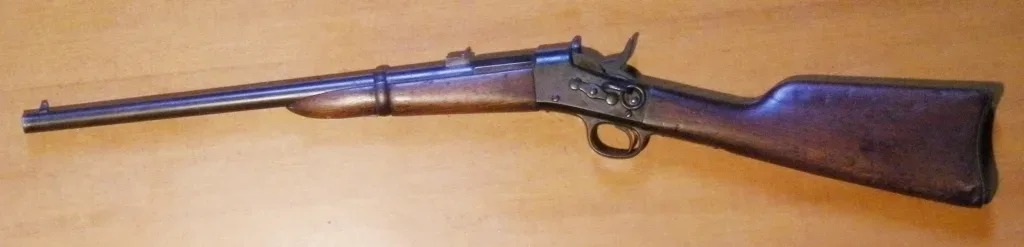
The Civil War transformed Remington from a significant regional manufacturer into a massive industrial operation. Remington supplied the Union Army with hundreds of thousands of Model 1863 Remington Army revolvers and Remington Rolling Block rifles, the latter of which became one of the most widely distributed military rifles in the world during the post-war period -- sold to armies across Europe, Latin America, and beyond. The Remington Rolling Block action was arguably the most produced single-shot military rifle design of the 19th century, and it came out of Ilion, New York.
Urban Regulations Emerge
New York City itself was a center of significant firearms commerce throughout the 19th century, with major dealers, importers, and some manufacturers operating in lower Manhattan. The city's dense population and its status as the primary port of entry for European immigrants made it a focal point for both firearms sales and, increasingly, concerns about firearms-related violence. Tammany Hall politicians who controlled city government for much of the latter 19th century had complicated relationships with firearms -- simultaneously representing immigrant communities who owned guns and seeking to control the weapons that fueled street violence in the tenement districts.
New York State enacted various firearms-related regulations throughout the 19th century -- restrictions on carrying concealed weapons, requirements around the sale of firearms to minors, and regulations governing the discharge of firearms within city limits. These were not unusual by national standards; most urbanizing states enacted similar laws during this period as cities grew and the need for some regulatory framework became apparent. What made New York different was the density of its urban population and the political will that density eventually produced.
The National Guard of New York -- successor to the state militia -- was formalized in the post-Civil War period and became one of the largest and most active state military forces in the country. The 7th Regiment of New York, known as the "Silk Stocking Regiment" for its upper-class membership, was among the most celebrated military units in the nation and maintained its own armory on Park Avenue in Manhattan, completed in 1880. Armories across New York City and the state served both military and social functions throughout the late 19th and early 20th centuries.
20th Century: The Sullivan Act, Two World Wars & Rising Restrictionedit
The Sullivan Act of 1911
The single most consequential moment in New York firearms law -- and arguably in American firearms law -- arrived on May 25, 1911, when Governor John Alden Dix signed the Sullivan Act into law. State Senator Timothy Sullivan, a Tammany Hall Democrat representing lower Manhattan, sponsored the legislation in response to what he framed as an epidemic of firearms violence in the immigrant neighborhoods south of 14th Street.
The law required licenses for any firearm small enough to be concealed, made unlicensed possession a misdemeanor, and made carrying without a license a felony.
| Provision | Requirement | Impact |
|---|---|---|
| Licensing | Required for concealable firearms | Gave police discretionary control |
| Unlicensed possession | Misdemeanor offense | Criminalized previously legal ownership |
| Carrying without license | Felony offense | Severe penalties for violations |
| May-issue system | Police discretion over permits | Enabled selective enforcement |
The Sullivan Act was explicitly a may-issue law -- local police authorities had discretionary control over who received licenses. That discretion was the point. Sullivan and his Tammany colleagues wanted a tool that gave city authorities control over who was armed, and the vague licensing criteria delivered exactly that.
Critics predicted the Sullivan Act would disarm law-abiding citizens while doing nothing about criminal violence. The law's selective enforcement validated those concerns almost immediately.
Critics at the time -- including Bat Masterson, the legendary lawman who was then working as a newspaper columnist in New York and called the law "obnoxious" -- predicted it would disarm law-abiding citizens while doing nothing about criminal violence. The law's selective enforcement, which fell heavily on immigrant and working-class communities rather than the well-connected, validated those concerns almost immediately.
The bribery potential built into the discretionary system became apparent within years of passage and metastasized over subsequent decades. The NYPD License Division bribery scandals that surfaced publicly in the 2010s -- in which officers accepted bribes from at least 2012 through 2016 in exchange for hundreds of permits -- were a modern manifestation of corruption dynamics that critics had identified in the Sullivan Act's structure from the beginning.
Despite -- or perhaps because of -- its controversial nature, the Sullivan Act became the model that gun control advocates pointed to nationally. A 2021 study examined its actual effects: no measurable impact on overall homicide rates, a reduction in overall suicide rates, and a large sustained decrease in gun-related suicide rates specifically. Those findings don't resolve the political debate, but they're the actual data.
World War Production
During World War I, New York's industrial capacity made it central to American war production. Remington Arms in Ilion and its subsidiary operations produced enormous quantities of military rifles, including the Model 1917 Enfield -- the most widely used American military rifle of the war -- under government contract. Remington also operated plants in Bridgeport, Connecticut, but the Ilion facility remained the company's core manufacturing operation.
The interwar period saw New York become a center of the national debate over firearms regulation. When Congress debated the National Firearms Act of 1934 -- triggered by Prohibition-era gang violence and the political shock of the attempted assassination of President-elect Franklin Roosevelt in Miami in 1933 -- New York's Sullivan Act was frequently cited as the existing model. Roosevelt himself was a former Governor of New York and brought that regulatory perspective to the federal debate.
World War II again turned New York's manufacturing capacity toward military production on a massive scale. Remington Arms produced millions of rounds of ammunition and hundreds of thousands of rifles for the war effort. Ilion operated around the clock. The Springfield Armory model of government production was supplemented by private contractors across the state.
Postwar Regulatory Expansion
The postwar period brought demographic shifts that intensified the political fault lines around firearms. New York City's population remained enormous but its manufacturing base declined, while crime rates rose through the 1960s and 1970s. Governor Nelson Rockefeller, who served from 1959 to 1973, oversaw significant expansions of state government and was generally supportive of stricter firearms regulation as part of his broader law-and-order agenda. The 1967 New York City Council enacted local regulations that went beyond even the Sullivan Act in restricting firearms.
The crack epidemic and associated violence of the late 1980s and early 1990s pushed New York City's murder rate to historic highs -- peaking at 2,245 homicides in 1990. This political environment drove additional regulatory responses at both the city and state level, even as federal legislation like the 1993 Brady Act and the 1994 federal assault weapons ban addressed similar concerns nationally.
Modern Era (2000–Present)edit
New York entered the 21st century with some of the most restrictive firearms laws in the country already on the books, and then made them significantly stricter. The trajectory of the modern era runs through three major events: the SAFE Act, the Bruen decision, and the legislative response to Bruen.
The NY SAFE Act
The NY SAFE Act -- Secure Ammunition and Firearms Enforcement Act -- was signed by Governor Andrew Cuomo on January 15, 2013, just one month after the Sandy Hook Elementary School shooting in Newtown, Connecticut. New York was the first state to pass major legislation in response to Sandy Hook, and Cuomo moved the bill through the legislature using a message of necessity that bypassed the standard three-day waiting period for legislative review -- a procedural move that itself generated significant controversy.
The SAFE Act's provisions were comprehensive by any measure. It reduced the permissible magazine capacity from ten rounds to seven (the seven-round limit was later modified when it became clear that seven-round magazines were not commercially produced for most firearms). It expanded the definition of assault weapons under state law, required registration of previously grandfathered assault weapons, mandated background checks for ammunition purchases, required mental health professionals to report patients they believed to be dangerous, expanded the state's pistol permit system, and required permit recertification every five years.
| SAFE Act Provision | Previous Law | New Requirement |
|---|---|---|
| Magazine capacity | 10 rounds | 7 rounds (later modified) |
| Assault weapons | Limited definition | Expanded features test |
| Background checks | Firearms only | Ammunition purchases included |
| Permit recertification | Not required | Every 5 years |
| Mental health reporting | Limited | Mandatory professional reporting |
The law generated immediate and intense opposition, particularly in rural New York. Sheriffs in dozens of upstate counties -- including Fulton, Montgomery, Chenango, Herkimer, and others -- publicly stated they would not proactively enforce provisions they considered unconstitutional, representing a significant law enforcement pushback unusual in New York's political history. Compliance rates with the assault weapons registration requirement were estimated to be extremely low -- the state registered approximately 44,000 weapons under the provision, while analysts estimated that hundreds of thousands of qualifying firearms existed in the state.
The Bruen Decision
On June 23, 2022, the Supreme Court issued its decision in New York State Rifle & Pistol Association, Inc. v. Bruen, striking down New York's proper cause requirement for concealed carry permits. The 6-3 decision, written by Justice Clarence Thomas, held that New York's requirement that applicants demonstrate a particularized need for self-defense beyond a general desire for protection violated the Second and Fourteenth Amendments. More significantly, the decision established a new framework for evaluating firearms regulations: modern gun laws must be consistent with the "historical tradition" of firearms regulation at the time of the founding.
Bruen was a direct challenge to the Sullivan Act's permit regime as it had evolved over 111 years. The decision did not strike down licensing requirements per se -- the Court was explicit that licensing itself was not the problem. The specific problem was the discretionary proper cause standard that gave local officials essentially unlimited latitude to deny permits to people who couldn't demonstrate a specific need beyond general self-defense.
Legislative and legal response timeline from Sandy Hook to present
Post-Bruen Legislative Response
New York's response to Bruen was immediate and aggressive. Governor Kathy Hochul called a special legislative session, and the Concealed Carry Improvement Act (CCIA) was signed into law on July 1, 2022 -- just eight days after the Bruen decision.
The CCIA added extensive new requirements to the permit process: sixteen hours of firearms safety training, one hour of live-fire training, in-person interviews, submission of social media accounts for review, and references from people familiar with the applicant. It also designated enormous numbers of locations as "sensitive places" where carry was prohibited -- including Times Square and most of New York City's density -- and required property owners to affirmatively post that they permitted concealed carry, making the default on private property a prohibition.
The CCIA was immediately challenged in federal court. In Antonyuk v. Nigrelli (2022), U.S. District Judge Glenn Suddaby issued a preliminary injunction blocking most of the law's provisions. The Second Circuit stayed the injunction while the appeal proceeded. The litigation continued through 2023 and 2024, with various provisions being upheld, struck down, and modified as cases worked their way through the courts. The Supreme Court declined in April 2024 to hear a challenge to New York's "good moral character" standard for permit applicants, allowing that requirement to stand.
In 2024, following the United States v. Rahimi decision in which the Supreme Court clarified that modern gun laws should align with the "principles" rather than the specific letter of historical firearms regulation, New York's ongoing litigation landscape shifted again. As of early 2026, the state's carry regime remains under active legal challenge, and the final shape of what New York's post-Bruen carry law will look like is still being determined in the courts.
Notable Figures & Manufacturersedit
Eliphalet Remington II (1793–1861) is the foundational figure of New York firearms manufacturing. His decision to forge his own rifle barrel in Ilion in 1816 rather than buy one from a gunsmith is one of those origin stories that turns out to be essentially true. Remington Arms in Ilion has operated continuously since the 1820s, making it one of the oldest continuously operating manufacturing sites in American history. The company survived the Civil War boom and bust, the transition from black powder to smokeless powder, two World Wars, multiple corporate restructurings, and a 2018 bankruptcy -- emerging as RemArms after the bankruptcy sale, still manufacturing in Ilion.
Samuel Colt had significant New York connections, particularly through his business dealings and investors, though his manufacturing was centered in Hartford, Connecticut. More directly New York-based was Savage Arms, which was founded in Utica, New York in 1894 by Arthur Savage. The company produced military and commercial arms from Utica for decades before eventually relocating manufacturing to Westfield, Massachusetts.
Ithaca Gun Company, founded in Ithaca, New York in 1883, produced shotguns that became staples of American hunting culture -- the Ithaca Model 37 pump shotgun, introduced in 1937, remained in continuous production for decades and was widely used by both hunters and law enforcement. Ithaca went through a series of corporate changes but maintained some manufacturing presence in New York into the modern era.
Timothy Sullivan (1862–1913), the Tammany Hall senator who sponsored the Sullivan Act, is a figure whose legacy is genuinely complicated. He was a genuine product of the Lower East Side immigrant world, with real connections to his constituents -- and real connections to organized crime. He died in 1913 under circumstances that remained mysterious (his body was found on railroad tracks in Westchester County), and his mental competence had been questioned in the months before his death.
George Petit le Brun, the New York City coroner's official whose letters and recommendations helped push Sullivan toward the 1911 legislation, was one of the first public health officials to argue systematically for firearms licensing based on mortality data -- a precursor to the modern public health approach to firearms regulation.
Hiram Percy Maxim, son of Hiram Maxim (inventor of the Maxim machine gun), invented the firearm suppressor in 1908 and sold them through his Maxim Silencer Company. While not a New York manufacturer, his father's work had deep New York financial connections -- Hiram Maxim developed the Maxim gun largely with backing from New York investors before establishing manufacturing in England.
Current Legal Landscapeedit
New York operates under one of the most restrictive firearms regulatory frameworks in the United States, though the exact shape of that framework is in genuine legal flux following Bruen.
Core Requirements
Handgun ownership requires a pistol permit issued by the county in which the applicant resides (or by the NYPD in New York City). The permit process includes background checks, character references, and in New York City, an in-person interview and extensive documentation. New York City remains functionally as restrictive as any jurisdiction in the country for obtaining a carry permit, though the proper cause language the NYPD previously relied on to deny most carry applications was struck down by Bruen.
The SAFE Act's assault weapons definition covers semi-automatic centerfire rifles and pistols with detachable magazines and one additional "military feature" (such as a pistol grip, thumbhole stock, folding or telescoping stock, forward pistol grip, flash suppressor, or grenade launcher), as well as semi-automatic shotguns with certain features. The magazine capacity limit for most purposes is ten rounds.
Key active restrictions include:
- Pistol permit required for purchase and possession of handguns
- Background checks required for all firearms transfers, including private sales
- Assault weapons registration required for pre-SAFE Act grandfathered weapons
- Magazine capacity limit of ten rounds
- Red flag law (ERPO) enacted in 2019, allowing courts to temporarily remove firearms from individuals deemed a risk
- Permit recertification required every five years
- Concealed carry requires a separate carry endorsement on the pistol permit, with training requirements added by the CCIA in 2022
The CCIA's sensitive places provisions -- which designated locations including Times Square, public transit, theaters, stadiums, houses of worship, and essentially all of New York City's public spaces -- remain under active litigation as of early 2026. Some provisions have been enjoined, others upheld, and the ultimate resolution awaits further appellate review.
Geographic Variations
Hunting remains a significant cultural and economic activity in New York, particularly in the Adirondacks, Catskills, and rural western and southern tier counties. The state's Department of Environmental Conservation administers hunting licenses and firearm-specific hunting regulations, including long-standing restrictions on the use of certain calibers for deer hunting in specific zones.
| Requirement Type | New York City | Upstate Counties | Rural Counties |
|---|---|---|---|
| Permit difficulty | Extremely high | Moderate-high | Moderate |
| Carry permits | Very restrictive | Restrictive | More accessible |
| Processing time | 6+ months | 3-6 months | 2-4 months |
| Interview required | Yes | Varies by county | Often waived |
New York does not recognize concealed carry permits from any other state. It has no reciprocity agreements and its permits are not valid in any other state. For most practical purposes, a New York handgun permit is only valid in New York.
The BGC Takeedit
If you're a gun owner in New York, your experience of firearms ownership is almost entirely determined by your zip code -- and that's not hyperbole, that's the legal architecture.
Live in Manhattan? You're operating in what is functionally the most restrictive handgun jurisdiction in the United States outside of Washington D.C. Getting a carry permit has historically required connections, documentation, and persistence that most ordinary citizens couldn't navigate. Post-Bruen, the CCIA changed the nominal standard but buried the practical access under training requirements, social media review, and sensitive place designations that cover nearly every place a New Yorker might actually go. The litigation will eventually resolve how much of that survives, but as of right now, carrying legally in New York City remains genuinely difficult for most people.
Live in Erie County or the Southern Tier? Different world. Pistol permits get issued. People hunt. The SAFE Act is resented but navigated. Plenty of gun stores, ranges, and hunters who have been doing this for generations and don't feel particularly well-represented by Albany.
That geographic and cultural fracture is the defining characteristic of New York firearms politics, and it's been baked in for a long time. The Sullivan Act itself was a New York City solution to a New York City problem imposed statewide -- and every major piece of legislation since has followed that same pattern. The political math works because New York City and its suburbs contain the majority of the state's population and dominate state politics.
What's genuinely interesting about the post-Bruen moment is that it's the first time in over a century that New York's regulatory apparatus has faced a serious constitutional check.
The state's response -- passing the CCIA within eight days of the Bruen decision -- tells you everything about how Albany views the Second Amendment relative to other constitutional rights. The legislature didn't sit down and ask what a compliant carry regime would look like. They asked how much they could restrict carry while nominally complying with the ruling's holding, and they pushed right to that line and arguably past it.
The ongoing litigation will probably trim the CCIA further. The courts have already blocked some of its most aggressive provisions. But the underlying political dynamic -- a state government that views firearms restriction as a policy good and will use every available tool to achieve it -- isn't going to change based on court decisions. The Bruen decision changed the legal framework. It did not change Albany.
For gun owners in rural New York, the frustration is real and understandable. They are a political minority in their own state, governed by firearms laws written by and for a city most of them never visit. The sheriffs who publicly declined to enforce SAFE Act provisions weren't being reckless -- they were expressing a genuine political and cultural reality that the state government doesn't fully reckon with.
For the historical record: New York gave America the Sullivan Act, which influenced firearms regulation nationally for over a century. It gave America Bruen, which is reshaping that regulation right now. And it gave America Remington, which put more rifles in more hands than almost any other manufacturer in history. The contradiction at the heart of New York firearms history -- the state that armed the nation also tried hardest to restrict what it armed -- is not getting resolved anytime soon.
Referencesedit
- Spitzer, Robert J. "Historic Weapons Licensing Laws." Duke Center for Firearms Law, June 4, 2025.
- New York State Rifle & Pistol Association, Inc. v. Bruen, 597 U.S. 1 (2022).
- District of Columbia v. Heller, 554 U.S. 570 (2008).
- Kachalsky v. Cacace, 701 F.3d 81 (2d Cir. 2012).
- Antonyuk v. Nigrelli, No. 22-CV-0986 (N.D.N.Y. 2022).
- Sullivan Act, New York Penal Law, signed May 25, 1911 (Gov. John Alden Dix).
- NY SAFE Act (Secure Ammunition and Firearms Enforcement Act), signed January 15, 2013 (Gov. Andrew Cuomo).
- Concealed Carry Improvement Act, signed July 1, 2022 (Gov. Kathy Hochul).
- New York Red Flag Law (ERPO), signed February 25, 2019.
- Swensen, David S. "Evidence from the Sullivan Act of 1911." Economic Journal, Montana State University, 2021.
- Welch, Richard F. King of the Bowery: Big Tim Sullivan, Tammany Hall, and New York City from the Gilded Age to the Progressive Era. SUNY Press, 2009.
- Haw, James. Storming the Heights: A Guide to the Battle of Saratoga. SUNY Press, 2008.
- Brownlee, Chip. "A Timeline of American Gun History." The Trace, June 4, 2025.
- NRA-ILA. "New York State Gun Laws and Regulations Explained." nraila.org.
- Rosen Institute. "Gun Law History in the United States and Second Amendment Rights." rockinst.org.
Last Updated: February 24, 2026
- Quail Creek Plantation(Okeechobee, FL)
- 2aHawaii(Honolulu, HI)
- Boston Firearms(Everett, MA)
- Safeshoot(Kingston, NY)
Loading comments...