Details
Firearm Cartridge

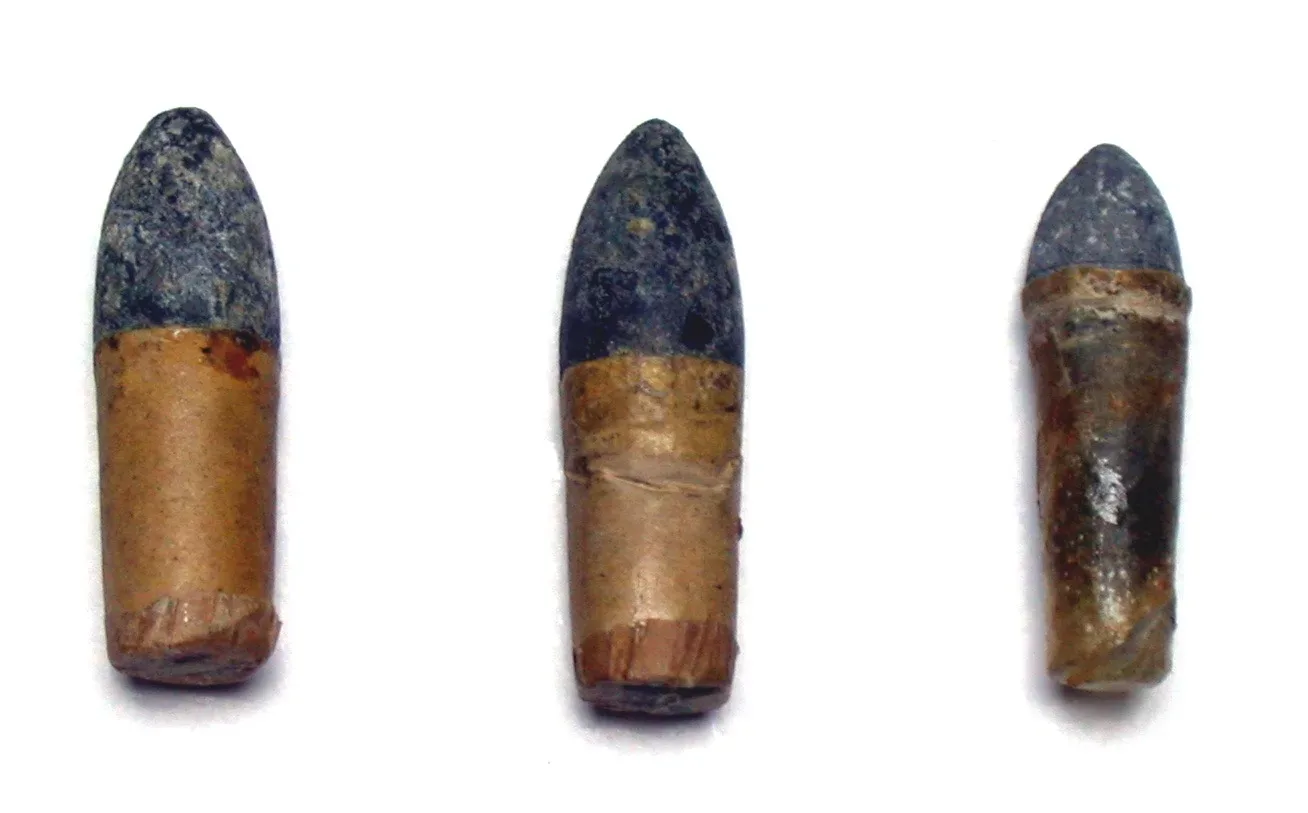
Colt's combustible cartridges burned entirely in the chamber, eliminating paper debris — a key innovation before metallic cases became standard.
| Origins | |
|---|---|
| Invented | 1808 |
| Inventor | Jean Samuel Pauly and François Prélat |
| Country | Switzerland/France |
| Timeline | |
| Era | Early 19th century to modern era |
| Impact | |
| Significance | The self-contained cartridge revolutionized firearm design by combining projectile, propellant, primer, and case, enabling breechloading, faster rates of fire, and automatic fire mechanisms. |
Firearm Cartridge
Firearms encyclopedia article
From The Boise Gun Club Handbook
Overviewedit
A firearm cartridge—also called a round—is a pre-assembled package that combines everything a gun needs to fire a single shot:
- A projectile (bullet, shot, or slug)
- A propellant (black powder, smokeless powder, or substitute)
- An ignition device (primer or percussion cap)
- A case that holds it all together
That case is precisely dimensioned to fit the chamber of a specific firearm.
In casual use, people say "bullet" when they mean cartridge. That's technically wrong—the bullet is only the projectile, the thing that leaves the barrel. The cartridge is the whole assembly. It's a distinction worth knowing, even if correcting strangers at the range is a fast way to make enemies.
The cartridge is not a single invention. It evolved over roughly four centuries, from a paper tube a soldier bit open with his teeth to the precision-drawn brass centerfire rounds that define modern firearms.
Understanding that evolution explains almost everything about why guns look and function the way they do today.
Development Historyedit
Early Paper and Ignition Systems
Paper cartridges predate everything else in this story by a considerable margin. The Dresden Armoury holds evidence of their use dating to 1591, and the writer Capo Bianco noted in 1597 that paper cartridges had "long been in use" by Neapolitan soldiers. A U.S. Army technical manual places the introduction of combined ball-and-powder cartridges for small arms at 1590. King Gustavus Adolphus of Sweden equipped his troops with them in the early 1600s, and the design is documented as having increased the rate of fire during the Thirty Years' War.
The paper cartridge was simple in concept. A measured powder charge and a lead ball were wrapped together in a paper cylinder with twisted ends.
To load, a soldier bit or tore off the base, poured the powder down the barrel, dropped in the ball, and rammed the paper in after it as wadding. A separate priming charge still had to be placed in the pan. The entire process—drilled into soldiers as "Load in Nine Times"—was slow, exposed to weather, and demanded both hands and a ramrod at a moment when an enemy might be charging.
The ignition systems improved steadily through the following centuries:
Major milestones in cartridge development from paper tubes to modern smokeless powder rounds
| Ignition System | Period | Key Features | Advantages | Disadvantages |
|---|---|---|---|---|
| Matchlock | Early 1400s+ | Burning wick lowered into priming pan | Simple mechanism | Weather vulnerable, exposed flame |
| Wheellock | 1500s+ | Spinning steel wheel struck against iron pyrite | More reliable than matchlock | Complex, expensive |
| Flintlock | Late 1600s+ | Spring-loaded hammer with flint strikes steel frizzen | Faster ignition, more reliable | Still exposed priming charge |
| Percussion Cap | 1807+ | Copper cap over conical nipple, struck by hammer | Weather resistant, faster loading | Required separate cap placement |
The Percussion Cap Revolution
The matchlock, developed in the early 1400s, used a burning wick lowered into a priming pan. The wheellock of the 1500s replaced the wick with a spinning steel wheel struck against iron pyrite. The flintlock, appearing in the late 1600s, used a spring-loaded hammer holding a piece of flint that struck a steel frizzen to produce sparks. Each generation was more reliable than the last, but all of them shared a common vulnerability: an exposed priming charge that wet weather could neutralize entirely.
The decisive shift came with the percussion cap. Edward Charles Howard discovered fulminates in 1800, and the patent by Reverend Alexander John Forsyth—filed in 1807 and covering the use of fulminating powder made of potassium chlorate, sulfur, and charcoal ignited by concussion—expired and opened the field to further development. Joseph Manton invented a precursor percussion cap in 1814, and the English-born American artist Joshua Shaw developed it further in 1822. The caplock system that resulted used a spring-loaded hammer to strike a small copper cap placed over a conical nipple, producing a spark that traveled through the nipple into the powder charge. It was faster to load, more resilient to damp conditions, and more reliable than anything before it.
The percussion cap also solved the priming problem permanently—and in doing so, made the self-contained cartridge not just possible but inevitable.
First Self-Contained Cartridges
Jean Samuel Pauly, a Swiss gunsmith working in Paris, got there first. In 1808, in collaboration with French gunsmith François Prélat, Pauly created what sources identify as the first fully self-contained cartridge. It incorporated a copper base with integrated mercury fulminate primer powder—the critical innovation—along with a round bullet and either brass or paper casing. The cartridge loaded through the breech and fired with a needle.
Pauly patented an improved version on September 29, 1812. The needle-activated centerfire breechloading concept he established became a defining feature of firearms development for the next century.
| Cartridge Type | Year | Inventor/Developer | Key Innovation | Limitations |
|---|---|---|---|---|
| First Self-Contained | 1808 | Jean Samuel Pauly | Copper base with integrated primer | Needle-fire mechanism complex |
| Pinfire | 1836 | Casimir Lefaucheux | Brass pin struck by hammer | External pin awkward, dangerous |
| First Rimfire | 1845 | Louis-Nicolas Flobert | Percussion cap with attached bullet | No separate powder charge |
| Metallic Pinfire | 1846 | Benjamin Houllier | First fully metallic case with powder | Still required external pin |
| American Rimfire | 1857 | Smith & Wesson | .22 Short for Model 1 revolver | Limited to low-pressure loads |
Rimfire vs. Centerfire Development
The next major step came from France again. Gunsmith Casimir Lefaucheux developed the pinfire cartridge in 1836. It used a thin brass-and-paper shell that expanded under firing pressure to seal the breech—an early form of obturation—with a small percussion cap at the base ignited by a brass pin projecting from the side of the cartridge and struck by the hammer. Lang of Cockspur Street, London introduced it to England around 1845. The pinfire gained significant popularity in Europe but never established itself in the United States, where the external pin was considered awkward and potentially dangerous.
Louis-Nicolas Flobert, a French gunsmith, produced the first rimfire metallic cartridge in 1845. His design was a percussion cap with a bullet attached to its mouth—no separate powder charge at all; the percussion compound itself provided the propellant energy. Flobert built what he called "parlor guns" around these cartridges for indoor shooting in large homes. The 6mm Flobert cartridges, known in English-speaking countries as the .22 BB Cap and .22 CB Cap, produce a muzzle velocity around 700 feet per second. They contain no powder—only the percussion cap compound.
French gunsmith Benjamin Houllier improved the Lefaucheux pinfire design and patented in Paris in 1846 the first fully metallic pinfire cartridge containing powder in a metallic case. His patent also claimed rim and centerfire primed cartridges using brass or copper casings.
In the United States, Flobert's design directly inspired the .22 Short in 1857, created for the first American revolver to use rimfire cartridges: the Smith & Wesson Model 1. The path to that revolver ran through a patent dispute. Rollin White, a former Colt employee, had conceived around 1852 the idea of boring revolver cylinders through to accept metallic cartridges. Samuel Colt refused the innovation; White left and licensed his patent to Smith & Wesson. That patent didn't expire until 1870, giving Smith & Wesson an effective monopoly on metallic cartridge revolvers for over a decade. The Colt Open Top (1871–1872) and Single Action Army (1873) followed once the patent lapsed.
The rimfire design had a structural limitation that became clear quickly: the case had to be thin enough for the firing pin to crush the rim and ignite the primer compound, which meant the case couldn't safely contain high-pressure loads. This constrained rimfire cartridges to lower-power applications and made them impractical for the larger rifle cartridges that military and hunting use demanded. Large rimfire rifle cartridges, including the .44 Henry and 56-56 Spencer (both introduced in 1860 and used in the Civil War), were soon replaced by centerfire designs capable of handling higher pressures.
Modern Centerfire Dominance
By 1866, the centerfire metallic cartridge was the direction the industry was moving. Hiram Berdan patented one primer design that year; Colonel Edward Mounier Boxer of the Royal Artillery patented another, also in 1866. The Berdan primer is a simple capsule; the anvil against which the primer compound is crushed is built into the cartridge case itself, with two small flash holes flanking it. The Boxer primer contains its own internal tripedal anvil and requires only a single central flash hole in the case. Commercially, Boxer primers dominate the handloading market because a standard decapping tool can punch the spent primer straight out through the central flash hole—a process that Berdan-primed cases, with their integral anvil blocking the center, do not permit.
In 1867, the British War Office adopted the Eley-Boxer metallic centerfire cartridge case for the Pattern 1853 Enfield rifles, converted to Snider-Enfield breechloaders. The original Eley-Boxer case was made of thin coiled brass—these cases occasionally unwound and jammed the breech with their own remains. The solid-drawn brass case, made from a single piece of metal with a thicker head, eventually replaced it and became the standard.
The 8mm Lebel cartridge, developed in 1886, marked another threshold: it was the first smokeless powder cartridge to be created and adopted by any country, opening the era of modern propellant chemistry.
How It Worksedit
The Firing Sequence
The mechanics of a cartridge firing are straightforward. When chambered, the cartridge sits with its case mouth forward, aligned with the bore, and the base resting against the bolt face or breechblock. Pulling the trigger releases the firing pin, which strikes the primer embedded in the base of the case.
The firing sequence from trigger pull to case extraction in a modern cartridge
The primer contains a shock-sensitive chemical compound—modern primers use lead styphnate and related materials—enclosed in a small button-shaped capsule seated in the primer pocket at the center of the case head. The impact crushes the compound against an anvil, producing a flash that travels through one or more flash holes into the interior of the case and ignites the main propellant charge.
The propellant deflagrates—burns rapidly—rather than detonating. This distinction matters: a detonation would destroy the firearm; deflagration produces controlled, progressive pressure rise.
The burning propellant generates expanding gases at very high pressure, often fire-forming the brass case outward against the chamber walls to seal the breech. With the breech sealed behind and the bullet seated in the case neck ahead, the only direction for the pressure to act is forward. When the pressure exceeds the friction holding the bullet in the case neck, the bullet separates and accelerates down the bore.
After the bullet exits the muzzle, chamber pressure drops back to ambient. The brass case, which had expanded elastically under pressure, contracts slightly—enough that the extractor can grip the rim or the extractor groove and pull the spent case rearward for ejection.
Case Construction and Materials
The case is the structural backbone of this sequence. Most modern cases are drawn brass—a sheet of brass is punched into disks, then run through a series of drawing dies with periodic annealing cycles to keep the metal workable. Brass is the material of choice because of its corrosion resistance, the ability to work-harden the case head to withstand pressure, and the ease of annealing the neck and body to remain ductile enough for reshaping and reloading.
Steel cases, used in some military and plinking ammunition—particularly from former Soviet republics, Russia, and China—are cheaper but corrode more readily and are not practical to reload. The higher stiffness of steel in the case neck can allow propellant gas to blow past and condense as fouling in the chamber, a problem less acute in Warsaw Pact-designed weapons that were built with looser chamber tolerances than NATO weapons. Aluminum cases are also commercially available but fatigue quickly under the stresses of firing and resizing, making them single-use items.
| Case Material | Advantages | Disadvantages | Primary Use |
|---|---|---|---|
| Brass | Corrosion resistant, reloadable, optimal expansion/contraction | Higher cost | Premium ammunition, reloading |
| Steel | Lower cost, strong | Corrodes, not reloadable, gas leakage issues | Military surplus, budget ammo |
| Aluminum | Lightweight, corrosion resistant | Fatigues quickly, single-use only | Specialized applications |
Headspacing and Classification
Cartridge cases are classified by their rim type, which determines how the case headspaces in the chamber and how the extractor engages it:
- Rimmed - rim seating against front of cylinder
- Semi-rimmed - intermediate design
- Rimless - headspacing on case mouth
- Rebated - rim smaller than case body
- Belted - reinforcing belt around case
Revolver cartridges are almost universally rimmed, the rim seating against the front of the cylinder. Semi-automatic pistol cartridges are almost universally rimless, headspacing on the case mouth.
Pressure Limits and Safety
Modern centerfire cartridges are commonly loaded to maximum chamber pressures of 65,000 psi (450 MPa). Rimfire designs have never been commercially loaded above 40,000 psi (280 MPa) due to the structural limitations of the thin-walled folded rim—thick enough to resist crushing means the firing pin can't detonate the primer; too hard and the rim cracks rather than deforms.
Cartridge specifications are governed by SAAMI (Sporting Arms and Ammunition Manufacturers' Institute) in the United States and C.I.P. (Commission internationale permanente pour l'épreuve des armes à feu portatives) in much of Europe. NATO maintains its own testing standards for military cartridges, and the differences in testing methodology mean a NATO cross-headstamped cartridge may present unsafe pressure levels in a firearm chambered for a commercially-spec'd cartridge.
A squib load deserves specific mention because the consequences are severe. A primer alone lacks the energy to propel a bullet out of the barrel, but it can separate the bullet from the case and push it partway into the bore—where it stops. Firing a subsequent live round behind an obstructing bullet generates dangerously high pressure in a confined space and can cause catastrophic failure of the firearm. Brandon Lee's death during the 1993 filming of The Crow is believed to have resulted from exactly this sequence: an undetected squib left a bullet in the bore, and a subsequently fired blank drove it with lethal force.
Impact on Warfare & Societyedit
Tactical Transformation
The paper cartridge already represented a meaningful tactical improvement—it pre-measured the powder charge and combined it with the projectile, reducing loading time and reducing the chance of powder-measure errors under stress. Gustavus Adolphus standardized its use at the army level in the early 17th century, and by the time of the American Civil War it was universal in military small arms.
But the paper cartridge still required a separate ignition system, still loaded at the muzzle, and still left the soldier vulnerable to weather. The rifled musket of the Civil War—the 1861 Springfield for the Union, the Pattern 1853 Enfield for the Confederates—used percussion-cap ignition with paper cartridges and a rifled bore. The rifling was the transformative element for that war: where smoothbore muskets were effective to under 100 yards and required volley fire, the rifled musket could engage man-sized targets at 800 yards.
According to sources describing the period, this range advantage made massed battlefield formations suicidal and forced soldiers into cover, producing the empty battlefield characteristic of modern warfare—a tactical reality that European armies would painfully relearn in the trenches of WWI.
Evolution of tactical capabilities enabled by cartridge development
The Breechloading Advantage
The self-contained metallic cartridge addressed the remaining problems. Loading at the muzzle with a long rifle and a ramrod while under fire was genuinely dangerous—a soldier had to stand up or at minimum kneel, exposing himself, to reload. Breechloading with a metallic cartridge allowed a soldier to reload from prone or behind cover. The Spencer Repeating Rifle, firing metallic cartridges, was adopted by Union forces after President Lincoln personally championed its purchase following a demonstration.
The Henry rifle of 1860 used a .44 Rimfire cartridge in a lever-action mechanism. These weapons offered rates of fire that single-shot muzzleloaders could not approach.
Enabling Automatic Fire
The transition was not frictionless. The brass cartridge case introduced a mechanical problem that hadn't existed before: extraction and ejection. A flintlock or caplock, once fired, was immediately ready for the next powder charge and ball. A breechloader with a metallic case required a mechanism to grip and remove the spent case, and that mechanism added complexity and new failure modes. Nineteenth-century inventors were acutely aware of this problem and experimented extensively with caseless and self-consuming cartridges before accepting that the advantages of brass far outweighed the extraction complication.
The development of the metallic cartridge also created the conditions for automatic fire. In modern self-loading firearms, the energy stored in the cartridge itself—either in the form of expanding gas tapped from the barrel or recoil force transmitted through the slide—operates the action. Without the self-contained cartridge providing a reliable, consistent energy source in a compact package, the mechanical cycling of semi-automatic and automatic weapons would have been impossible. John Browning's observation that gas from a fired cartridge could operate the gun's own mechanism—reportedly inspired by watching grass bend in the muzzle blast of a rifle—depended entirely on the cartridge's consistent, repeatable energy output.
International Military Standards
The choice of cartridge has also shaped military outcomes directly. The German 8mm Mauser (7.92×57mm) cartridge in the 1898 Mauser rifle demonstrated superiority over American forces at the Spanish-American War of 1898 and over British forces in the Boer War. The American response, the .30-06 Springfield (literally "a .30-caliber cartridge developed in 1906"), closely followed the Mauser design philosophy of smaller, faster, more aerodynamically efficient bullets and remained the standard U.S. military rifle cartridge for the first half of the 20th century.
The German decision during WWII to develop an intermediate cartridge—the 7.92×33mm Kurz, using a standard Mauser bullet with a shortened case—gave rise to the Sturmgewehr 44 and the concept of the assault rifle. The Soviet 7.62×39mm of the AK-47 applied the same logic. Eugene Stoner's 5.56×45mm for the AR-15 reversed the formula, pairing a large case with a small, very fast bullet to exploit the kinetic energy equation at the expense of bullet mass.
The Hague Convention of 1899 addressed cartridge design directly, banning the use of expanding projectiles against the military forces of other nations—a restriction that remains in effect for military use while civilian and law enforcement applications of hollow-point ammunition continue under different frameworks.
Modern Relevanceedit
Current Cartridge Standards
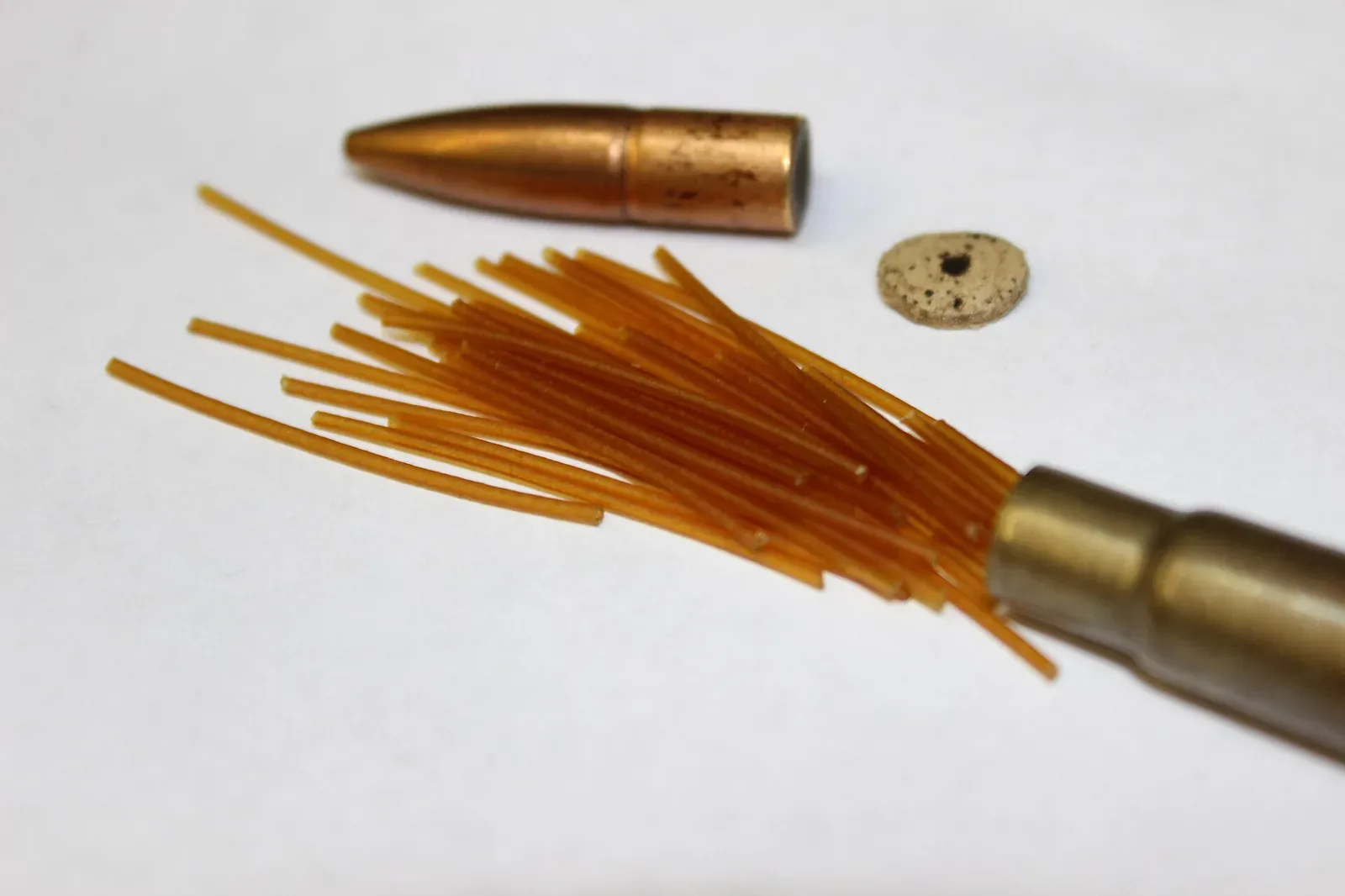
The basic four-component cartridge—case, primer, propellant, projectile—has remained structurally unchanged for over 150 years. What has changed is the precision of manufacture, the chemistry of propellants and primers, and the engineering of projectile designs.
Today, only two primer designs have survived in mainstream use: centerfire and rimfire. Pinfire cartridges still exist but are confined to rare novelty miniature guns and small blank cartridges used as noisemakers. Among rimfire cartridges, the .22 Long Rifle accounts for the vast majority of all rimfire ammunition produced. Among centerfire rifle cartridges, the .308 Winchester (the commercial version of the 7.62×51mm NATO round, which Winchester introduced to the hunting market two years before NATO's 1954 adoption) is the most popular short-action big-game hunting round worldwide and the standard NATO sniper and medium machine gun chambering.
| Cartridge | Type | Primary Use | Adoption |
|---|---|---|---|
| .22 Long Rifle | Rimfire | Sport shooting, training | Most popular rimfire worldwide |
| 9×19mm Parabellum | Centerfire pistol | Military, law enforcement | NATO standard pistol round |
| 5.56×45mm NATO | Centerfire rifle | Military infantry | NATO standard rifle round |
| 7.62×39mm | Centerfire rifle | Military, civilian | Kalashnikov series standard |
| .308 Winchester/7.62×51mm | Centerfire rifle | Hunting, precision shooting | NATO sniper/machine gun standard |
Advanced Development Programs
The 5.56×45mm NATO became the standard NATO rifle round in the early 1980s, displacing the 7.62×51mm for general infantry use. The 7.62×39mm of the Kalashnikov series remains one of the most widely distributed cartridges in the world by volume. The 9×19mm Parabellum, invented for the German military at the turn of the 20th century, is the NATO standard pistol and submachine gun round.
Caseless ammunition—in which the entire case assembly is consumed during firing or ejected with the bullet—remains an active development goal for military applications. The Heckler & Koch G11, advertised in 1989, fired a 4.73×33mm caseless round with an integral primer fired by mechanical means. Voere of Austria began selling an electronically fired caseless system in 1993, using a primer ignited at 17.5 volts—voltage limits set to prevent ignition from stray electrical currents or static. Neither has achieved commercial success or widespread military adoption.
The fundamental problem—gas leakage at the chamber when there is no expanding case to obturate the breech—has plagued caseless designs since the Sharps paper-cartridge system of around 1848 and remains unsolved at scale.
Projectile and Material Innovation
Polymer-cased centerfire ammunition is a more recent development, with manufacturers exploring composite cases to reduce weight and manufacturing costs. Steel and aluminum cases remain in production for cost-sensitive markets. The True Velocity company, per American Rifleman, has developed polymer-cased centerfire rifle cartridges as part of ongoing military ammunition development programs, though this article's sources contain only limited detail on that effort.
On the projectile side, lead remains the traditional material for its density, malleability, and low cost, but environmental concerns have driven development of bismuth, tungsten, and other alternatives for hunting and range use. Armor-piercing designs use hardened steel, tungsten, tungsten carbide, or depleted uranium penetrator cores. Jacketed hollow-point projectiles—developed after the Indian Army's experiments at Dum-Dum Arsenal near Kolkata produced the jacketed soft-point design in the late 19th century—are the standard for defensive handgun ammunition. The Hague Convention restricts expanding projectiles in military use; the United States did not sign the complete convention but follows its guidelines in military conflicts.
Handloading and Nomenclature
Handloading—the practice of assembling cartridges from component cases, primers, powder, and bullets—is a significant segment of the shooting market, driven primarily by the cost advantage over factory ammunition and the ability to tailor loads to specific firearms. Boxer-primed brass cases can be reloaded many times; the case neck is annealed periodically to restore ductility. Wildcat cartridges, created by reshaping existing case designs, represent the outer edge of handloading experimentation and have historically been the origin point for many cartridges that later achieved commercial standardization.
Cartridge nomenclature remains a persistent source of confusion. The name of a cartridge does not necessarily reflect any actual dimension. The .38 Special has a nominal bullet diameter of 0.357 inches; the case diameter is 0.380 inches, and the name reflects the diameter of the cylinder chambers of the converted cap-and-ball revolvers the cartridge was originally designed to fit. The .30-06 Springfield encodes its bullet diameter (.30 caliber) and the year of its adoption (1906). The 7.62×51mm NATO encodes bore diameter and case length in millimeters. Older black powder cartridges like the .50-90 Sharps encode bore diameter and nominal powder charge in grains.
The BGC Takeedit
The cartridge is the hinge point of the entire 800-year story of firearms. Everything before it was iterative improvement on a fundamentally awkward system where the shooter had to act as their own ammunition assembly line.
What's underappreciated is how many things had to align simultaneously for it to work. Pauly's 1808 cartridge needed the fulminate chemistry that Howard had just worked out in 1800. The metallic case needed the industrial capacity to draw brass to consistent tolerances, which wasn't economically feasible at scale until the 1870s and 1880s. The breechloading mechanism needed the cartridge to obturate the chamber reliably, which required both the chemistry of case expansion and the metallurgy to make a case that would expand under pressure and then contract enough to extract. Pull any one of those threads and the whole system falls apart.
The part that doesn't get enough attention is the extraction problem. Every mechanical complication in a modern firearm's action—the extractor, the ejector, the timing of the bolt's unlock relative to pressure drop—exists because someone decided to package the propellant in a brass case that has to come back out. The flintlock musket had a simpler mechanism in that specific sense. The trade was absolutely worth it, but nineteenth-century designers weren't wrong to view it as a genuine engineering burden. The history of malfunctions in firearms is substantially the history of extraction failures.
The rimfire versus centerfire division is also worth sitting with for a moment. The rimfire works because of a manufacturing trick—spinning liquid primer compound into a hollow rim and letting centrifugal force distribute it, then heat-drying it in place. It's elegant and cheap to produce, which is why the .22 LR is the highest-volume sporting cartridge in the world by a wide margin. But the physics of the thin-walled rim set a hard ceiling on pressure, and that ceiling kept rimfire ammunition out of high-power applications permanently. The centerfire won the performance argument decisively. The rimfire won the economics argument for small-caliber use, and that's why both still exist.
If you want a single artifact that represents the transformation of firearms from a craft technology to an industrial one, the drawn-brass centerfire cartridge case is probably it.
The machinery to produce it at scale, the metallurgy to make it work reliably, the chemistry to make the primer consistent—all of that had to be invented alongside the cartridge itself. The cartridge didn't just change how guns worked. It created an entirely new industry to supply them.
Referencesedit
- https://en.wikipedia.org/wiki/Cartridge_(firearms)
- https://www.nrablog.com/articles/2016/5/a-brief-history-of-firearms-the-self-contained-cartridge/
- https://library.ucdavis.edu/exhibit/firearms-history-and-the-technology-of-gun-violence/
- https://www.hunter-ed.com/national/studyGuide/History-of-Firearms/201099_92986/
- https://oklahomarifle.org/a-brief-history-of-firearms-self-contained-cartridge/
Last Updated: February 27, 2026
- Gls Guns(Sumner, IA)
- Bi-mart - Yakima (Fruitvale Ave)(Yakima, WA)
- New Philly Sportsman Specialities(New Philadelphia, OH)
- R&R Sports & Outdoors(Brandon, FL)
Loading comments...